
Auto Expert John Cadogan positions itself as a vital resource for navigating the complexities of the automotive world, particularly within the highly competitive Australian market. The channel delves into the everyday realities of car ownership, addressing common frustrations and offering insights into the decision-making processes behind purchasing and maintaining vehicles. It aims to demystify the automotive landscape for consumers, providing expert guidance on a range of topics.
With a focus on practical advice and in-depth analysis, Auto Expert John Cadogan covers essential aspects of vehicle ownership, from the nuances of upgrading older cars to the critical factors influencing tyre performance and safety. The channel also engages with contemporary issues such as electric vehicle (EV) technology, exploring both the potential and the challenges associated with their widespread adoption and integration into existing infrastructure.
With a focus on practical advice and in-depth analysis, Auto Expert John Cadogan covers essential aspects of vehicle ownership, from the nuances of upgrading older cars to the critical factors influencing tyre performance and safety. The channel also engages with contemporary issues such as electric vehicle (EV) technology, exploring both the potential and the challenges associated with their widespread adoption and integration into existing infrastructure.

When Should I Upgrade My Old Car? | Auto Expert John Cadogan
John Cadogan tackles the perennial question of when to upgrade a vehicle, offering a pragmatic perspective that challenges the industry's push for constant turnover. He argues that keeping a car longer significantly reduces depreciation and environmental impact, directly refuting the "greenwashin...



Latest Additions
Showing 24 of 285 total titles. Page 10 of 12.

Preparing for Australia's Power Failures with the Bluetti AC300
John Cadogan addresses the increasing likelihood of power failures in Australia, particularly on the eastern seaboard, urging viewers to prepare. He i... morentroduces the Bluetti AC300 and B300 battery system as a robust solution for home backup power. Cadogan highlights the system's modularity, allowing up to four B300 batteries for substantial energy storage (over 12 kWh), and its 3000W continuous output. He contrasts this with rooftop solar, which often shuts down during grid failures, and emphasizes the AC300's ability to function as an Uninterruptible Power Supply (UPS). The review details the system's various outlets, charging options (including solar), and app control. Cadogan provides a practical energy budget for essential appliances like refrigerators and electronics, suggesting around 3 kWh per day is a reasonable target for home backup. He also offers advice on managing lighting and cooking with alternative energy sources like gas to conserve battery power. The overall verdict is that the Bluetti AC300 system offers a comprehensive and reliable solution for emergency power needs, provided users plan their energy consumption. less

DIY Wheel Chocks - Off-Grid with the Bluetti AC200MAX
John Cadogan demonstrates how to create a set of durable DIY wheel chocks from scrap plywood, emphasizing a 'ghetto engineering' approach th... moreat prioritizes practicality and repeatability over meticulous measurement. The project is powered entirely off-grid using the Bluetti AC200 MAX portable power station, showcasing its capability to run tools like a drop saw and a pneumatic compressor. While the AC200 MAX handled most tasks, it struggled with the compressor's cycling under load, requiring a workaround. Cadogan highlights the Bluetti's suitability for general carpentry and fabrication but cautions against using it for highly demanding, high-inertia tools without thorough testing. The review concludes that the DIY chocks are functional and cost-effective, offering a satisfying alternative to purchasing commercial ones, and underscores the Bluetti's utility for off-grid power needs, even during potential grid failures. less

The Truth About BMW's Subscription Model for Heated Seats, Etc
John Cadogan critically examines BMW's controversial 'functions on demand' subscription model, particularly the initial uproar over hea... moreted seats. He clarifies that features ordered from the factory, like heated seats, will not be disabled. However, BMW is indeed offering optional features, such as wireless Apple CarPlay and automatic high beams, via one-off purchases or subscriptions. Cadogan expresses skepticism about the value proposition of features like the drive recorder, likening it to a protection racket and questioning the necessity of paying for basic functionalities. He argues that while subscriptions are becoming normalized, there must be a balance, and core features like steering and lights should always work out of the box. The review highlights the philosophical line where paying for automotive features becomes unreasonable, comparing it to paying extra for toilet flush features in a house. Ultimately, Cadogan suggests that paying for such subscriptions, especially for basic comfort features, is an 'IQ test' for consumers. less
The Truth About Nissan Qashqai E-Power 2023 Series Hybrid in Australia
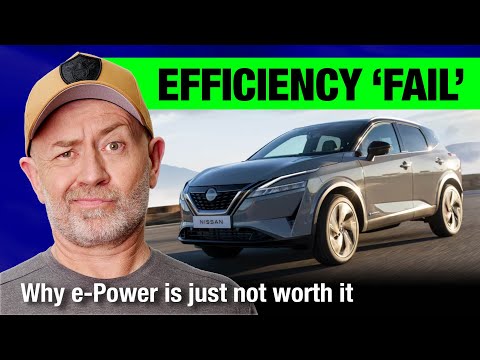
John Cadogan delivers a scathing review of the Nissan Qashqai e-Power, criticizing both Nissan's marketing and the Australian automotive press fo... morer their handling of the vehicle's launch. He highlights the e-Power system's complexity, arguing that its series hybrid design, with an engine acting solely as a generator, is inherently less efficient than other hybrid or EV systems due to multiple energy conversion losses. Cadogan points out the "anorexic" 2.1 kWh battery, which he believes is too small to provide meaningful EV-only range or support the 140 kW electric motor for extended periods without significant strain. He questions Nissan's battery reliability track record and the system's complexity, suggesting it compromises long-term dependability. Furthermore, Cadogan calculates that the e-Power's marginal fuel savings over the conventional petrol Qashqai do not justify the estimated $5,000 price premium, making it a poor financial proposition. His overall verdict is that the Qashqai e-Power is an interesting engineering "footnote" but not a viable commercial product for saving money or the planet. less

How the Fake News Around Cars and Climate Really Works
John Cadogan critically dissects the pervasive fake news surrounding cars and climate emissions in Australia. He argues that industry bodies like the ... moreFCIA and media outlets often misrepresent crucial data, such as the actual percentage of transport emissions attributed to cars. Cadogan highlights discrepancies in reporting, particularly concerning the potential impact of emissions caps, contrasting claims of significant national emission reductions with the reality of cars being a smaller, though still relevant, part of the overall problem. He criticizes the automotive press for acting as "PR amplifiers" rather than journalists, often regurgitating press releases without proper fact-checking. The review points out that while cars contribute 8% to total Australian emissions, other sectors like agriculture and stationary energy are significantly larger contributors. Cadogan suggests that focusing on public education for efficient driving and promoting remote work are more immediate and effective solutions than solely relying on new car purchases or stringent tailpipe emission caps. less

What Size Battery Do You Need, Off-Road or Off-Grid?
John Cadogan's review delves into the practicalities of selecting an off-grid power system, emphasizing the importance of understanding energy re... morequirements over simple amp-hour ratings. He thoroughly examines the BLUETTI AC200 MAX and its expansion capabilities, highlighting its pure sine wave output, versatile charging options (including solar), and robust construction. Cadogan praises the AC200 MAX's performance, citing its ability to handle demanding tasks like running power tools and even a mig welder briefly. He strongly advises against using electricity for cooking, advocating for gas due to its superior energy density and cost-effectiveness. The review also touches upon the risks associated with DIY electrical systems and generators, positioning the BLUETTI as a safer, more integrated, and user-friendly alternative for portable power needs. A key takeaway is the critical need for electrical safety precautions when using any 240V AC off-grid power supply. less

The Truth About "Fossil-Free" Steel for Cars: It's a Pipedream
John Cadogan delivers a scathing critique of Volvo Trucks' "fossil-free" steel initiative, labeling it a "disingenuous green utopi... morean" PR stunt. He argues that the process, which relies on hydrogen and bio-oil, is not scalable and distracts from more effective, immediate climate solutions like increased steel recycling. Cadogan meticulously breaks down conventional steel production, highlighting the significant CO2 emissions involved. He then dissects the "HYBRIT" process, pointing out that 95% of global hydrogen production is currently fossil-fuel-based and that bio-oil is insufficient for global scale. The review emphasizes that true green action requires increasing vehicle lifespan and reducing vehicle weight, rather than pursuing unproven, large-scale "green" steel technologies. Cadogan concludes that Volvo Trucks and the Swedish government should be ashamed for promoting a "pipedream" that offers no immediate climate benefit. less

The Worst Thing About Owning an EV
John Cadogan delivers a scathing critique of EV charging infrastructure in Australia, highlighting the "third world" reality faced by owners... more attempting longer journeys. While acknowledging the merits of EVs in reducing urban pollution and foreign oil dependency, he argues that the current charging network is unreliable and "rooted," citing personal experiences with broken chargers and inaccurate apps. Cadogan contrasts this with the BMW X3 plug-in hybrid (xDrive30e M Sport), which he praises for its practicality, performance, and ability to bridge the gap to a full EV future without range anxiety. He notes the PHEV's sufficient electric-only range for daily commutes and its seamless transition to hybrid mode for longer trips. However, he stresses the importance of plugging in PHEVs for optimal performance and efficiency, suggesting that for those who can afford it, a PHEV offers a more practical and less stressful entry into electrified motoring than a full EV, given the current state of public charging.
Cadogan also voices strong disapproval of government EV subsidies, deeming them "immoral" for benefiting the affluent and diverting taxpayer funds from essential services. He advocates for incentives that promote the development of reliable, high-uptime charging infrastructure instead. less
Cadogan also voices strong disapproval of government EV subsidies, deeming them "immoral" for benefiting the affluent and diverting taxpayer funds from essential services. He advocates for incentives that promote the development of reliable, high-uptime charging infrastructure instead. less

Full Of It: Breaking Down Car Industry CO2 & Climate Claims | Auto Expert John Cadogan
John Cadogan critically dissects the Australian car industry's CO2 emissions targets and climate claims, labeling them as fictitious and unambiti... moreous. He highlights the industry lobby group FCAl and its head, T-Dub (Matthew Callahar of Toyota), for presenting a "no balls standard" that allows manufacturers to meet targets by accumulating credits without penalties for exceeding them, particularly in the heavy SUV and light commercial vehicle segments. Cadogan points out that while passenger cars narrowly met their target, heavy vehicles significantly overshot it, yet the industry is lauded for "signing up." He argues this system, heavily influenced by Toyota's market share, is designed to make the brand appear environmentally conscious despite its high-emission vehicle sales. The review concludes that the industry's primary goal is to sell more cars, not genuinely address climate change, and suggests a shift towards taxing heavy vehicles and investing in renewables as a more effective solution. less

Ultimate Portable Power Solution? New Bluetti AC200MAX - Full Test!
John Cadogan provides an in-depth review of the Bluetti AC200MAX portable power station, highlighting its evolution from the AC200P. He praises its su... morebstantial 2048 Wh LiFePO4 battery, versatile output options including multiple AC outlets, USB ports, and 12V DC ports, and a significant 2200W continuous power output with a 4800W surge capacity. Cadogan demonstrates its capability by powering demanding tools like a 2.4 horsepower drill press and even a MIG welder, albeit with some limitations and tripping on the latter. He notes the unit's ability to be charged via AC and solar simultaneously, offering potential for near-indefinite power with sufficient solar input. While acknowledging the premium price point, Cadogan concludes the AC200MAX is a "keeper" for tradies, campers, and those needing reliable backup power, appreciating its portability and modular expansion capabilities with additional battery packs. The review emphasizes its practical application in off-grid fabrication scenarios. less

Car Industry Declares War on Climate Change (and Fails)
John Cadogan critically assesses the Australian car industry's claims of combating climate change, labeling their efforts as a "smoke screen... more" and "greenwashing." He argues that the industry, represented by lobby groups like the FCAI, focuses on arbitrary emissions targets and marketing buzzwords rather than substantive action. Cadogan highlights the significant increase in vehicle weight over the past two decades, citing examples like the Toyota Yaris and Mazda 3, as a primary contributor to higher emissions, a factor the industry deliberately ignores. He contends that the industry's true priority is selling cars, particularly larger SUVs, and that their proposed solutions, such as hybrids and efficient internal combustion engines, are insufficient. Cadogan advocates for improved public transport and reduced vehicle mass as more effective climate solutions, dismissing the industry's narrative as a self-serving attempt to maintain business as usual under the guise of environmental responsibility. less

Q&A - Super Select 2 & A Vital EV Test Drive Rego Compliance Check | Auto Expert John Cadogan
This episode addresses viewer comments, focusing on Mitsubishi's Super Select II 4WD system and EV registration compliance. The reviewer clarifie... mores that Mitsubishi's Super Select II allows 4H to be used on high-traction surfaces like bitumen with the center diff unlocked, enhancing safety and reducing wheelspin. Unlike other utes, this system prevents driveline damage on such surfaces. While shifting into 4H is permitted at any speed, the manual specifies shifting *between* 2H and 4H must occur below 100 km/h. The video also highlights a critical EV compliance issue: the absence of the mandatory blue EV triangle safety label on a Polestar's number plates, which can result in fines and demerit points for drivers. The reviewer notes that while the specific car in the thumbnail was photographed during a sticker exemption period, Polestar's subsequent press materials also lacked the label, indicating potential ongoing non-compliance. A public service announcement advises EV/hybrid test drivers to check for these labels before driving. less

Bluetti EB55 Portable Power Station Review For 4X4s, Caravans & Boats
John Cadogan provides an in-depth review of the Bluetti EB55 portable power station, highlighting its suitability for off-road vehicles, caravans, and... more boats. He praises its affordability, compact size, and ease of use, noting its capacity to power various devices through its multiple output ports, including AC, DC, and USB. Cadogan demonstrates its capability by successfully drilling through steel, showcasing its 700W continuous power output and 1400W surge protection, which handles demanding tools like angle grinders effectively. He also commends the LiFePO4 battery's longevity, estimating over 2500 charge cycles. While recommending the EB55 and its larger sibling, the AC200P, for their reliability and value, especially during the current sale, Cadogan advises caution regarding airflow and water resistance, and strongly emphasizes the electrical safety precautions necessary when using such high-power devices. less

Responding to Your EV Battery Thermal Runaway Comments and Criticism
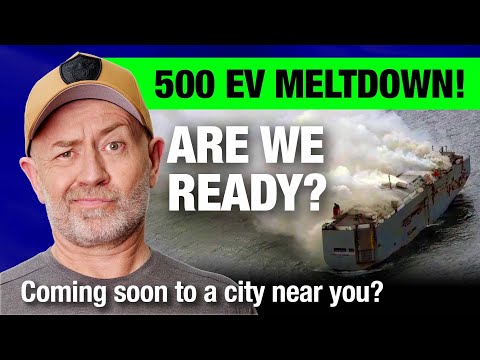
This video addresses viewer comments regarding EV battery thermal runaway, specifically in response to a previous report on the Felicity Ace incident.... more The host, John Cadogan, defends his critical stance on Volkswagen's handling of the incident and the broader implications for EV safety. He refutes claims that he is anti-EV, asserting his focus is on safety procedures and the unique challenges posed by EV fires compared to internal combustion engine vehicles. Cadogan elaborates on the science of thermal runaway, explaining that while LFP batteries are generally safer and less prone to it than other lithium-ion chemistries, they are not immune. He highlights that all lithium-ion batteries can experience thermal runaway under certain conditions, such as overcharging or external heating, and that they generate their own oxygen, making them difficult to extinguish with conventional methods like foam. The host emphasizes the need for improved safety protocols in the maritime transport of EVs and criticizes the tendency for online commenters to misinterpret his safety-focused commentary as anti-EV sentiment. less
Thermal Runaway: The Potential Disaster Hidden in Every Electric Car
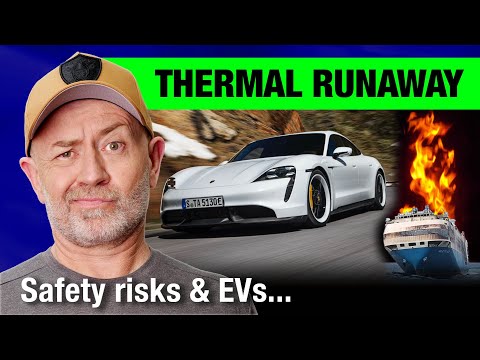
This video details the catastrophic sinking of the Felicity Ace cargo ship, which was carrying thousands of Volkswagen Group vehicles, including elect... moreric Porsches. The central thesis is the inherent danger of lithium-ion batteries in EVs, specifically their susceptibility to thermal runaway. While the exact cause of the fire on the Felicity Ace remains unconfirmed, the presenter strongly argues that the EV batteries significantly exacerbated the blaze, leading to the ship's destruction and a substantial environmental hazard. The review highlights a perceived lack of stringent, mandated safety standards for EV batteries and their shipping, contrasting this with the stricter regulations for batteries on commercial aircraft. The presenter criticizes Volkswagen for prioritizing cost-cutting and production over safety, likening the situation to the Boeing 737 MAX disasters. The core message is a stark warning about the potential for thermal runaway in EVs and the urgent need for better safety protocols and regulations. less
Hyundai Hydrogen Upgrade Highlights The Real Problem With Climate Action
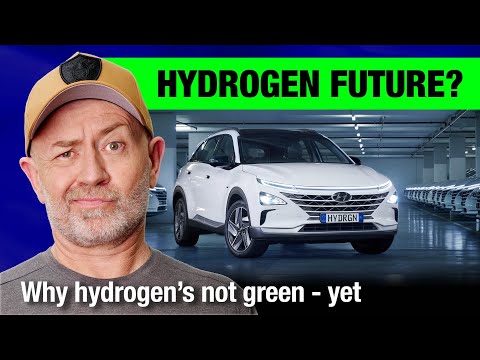
The reviewer critically examines Hyundai's investment in hydrogen fuel cell technology, specifically the Nexo SUV, highlighting a significant dis... moreconnect between the "green" image and the actual production of hydrogen. The core argument is that current hydrogen production methods, primarily steam reforming of methane, are environmentally damaging, releasing substantial CO2. While acknowledging the Nexo's zero tailpipe emissions, the reviewer emphasizes that the fuel's "dirtiness" negates its environmental benefits. A major point of contention is the slow progress and perceived lack of urgency from Hyundai in Australia to implement green hydrogen production, taking eight years to upgrade their refueller with an electrolyzer. The reviewer contrasts this with the ACT government's earlier adoption of on-site hydrogen production, attributing it to government entities not being bound by economic rationality. Ultimately, the video criticizes the economic realities and "bean counter" mentality as the primary impediment to genuine climate action, suggesting that governments should heavily incentivize green hydrogen to overcome these hurdles. The reviewer praises the ACT government and Hyundai for their efforts, albeit with reservations about the pace and scale. less

Greenwashing Is the New Black for the Car Industry
John Cadogan critically dissects the automotive industry's pervasive use of 'greenwashing,' using Polestar's Nullarbor crossing st... moreunt as a prime example. He argues that claims of carbon neutrality, particularly when using waste cooking oil to recharge EVs via a diesel generator, are scientifically illiterate and misleading. Cadogan highlights the significant, often ignored, carbon footprint associated with the generator's manufacturing, transportation, servicing, and the processing of the waste oil itself. He contrasts this with the true nature of hydrocarbons as natural carbon capture systems. The review emphasizes that such marketing tactics prey on a scientifically illiterate public and that true sustainability requires a more rigorous, honest approach, not just virtue signaling. The video concludes that sounding green is far easier than actually being green, with the car industry exploiting this gap. less
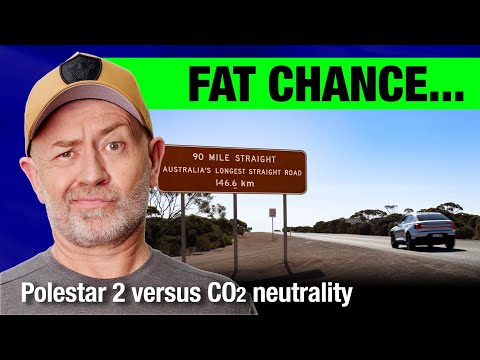
About Polestar 2 Crossing the Nullabor, Running on Chip Fat Power
John Cadogan critically examines Polestar's recent stunt of driving a Polestar 2 across the Nullarbor and charging it with a chip fat-powered gen... moreerator. While acknowledging the ingenuity of the remote charging solution, Cadogan vehemently debunks Polestar's claims of 'CO2 neutrality' and 'world-first' innovation. He meticulously details the extensive carbon footprint associated with vegetable oil production, from industrial agriculture and transportation to processing and container manufacturing, arguing that burning chip fat is far from a net-zero exercise. Cadogan criticizes the automotive industry's tendency to promote consumption, even of EVs, as a climate solution, labeling such narratives as "malignant greenwashing" and a significant impediment to genuine climate action. He concludes that while the remote charging concept is commendable, Polestar's misrepresentation of its environmental impact demonstrates a fundamental lack of scientific literacy or a deliberate attempt to mislead. less

Why 'Zero Emissions Vehicle' Will Be the Great Auto Industry Lie of 2022
John Cadogan critically dissects the 'zero emissions' marketing narrative surrounding electric vehicles (EVs), arguing it's a significa... morent industry lie. He contends that while EVs do have lower lifecycle emissions than combustion engine cars (approximately 21% less, according to cited research), the manufacturing process for EVs generates substantially more CO2 equivalent emissions (8.8 tonnes vs. 5.6 tonnes for combustion cars). Cadogan dismisses the 'zero emissions' claim as misleading, highlighting that the true environmental impact includes production, material sourcing, and electricity generation. He suggests that simple driving efficiency improvements in existing combustion vehicles can yield comparable emission reductions. The reviewer concludes that EVs serve as a governmental smokescreen and a profitable avenue for car manufacturers to collaborate with regulators, diverting attention from the larger issue of fossil fuel extraction and consumption, particularly coal in Australia. He acknowledges climate change is real and human-caused but stresses the importance of factual accuracy over marketing spin. less

Why Is Tesla Selling 2021 Cars With 2017 Batteries?
This video critically examines Tesla's practice of selling 2021 model year cars equipped with battery packs manufactured as early as 2017. The co... morere issue highlighted is the significant, up to 12%, reduction in range due to battery age, even with low mileage. The reviewer expresses dismay at this practice, contrasting it with the transparency expected from other manufacturers. He questions the warranty implications and the long-term impact on resale value, arguing that consumers are not being adequately informed about this gradual range degradation. The piece also touches on broader themes of consumer trust, the marketing of EVs, and the need for greater honesty regarding battery performance over time. While acknowledging Tesla's innovations, the reviewer emphasizes that battery technology itself is not exclusive and that consumers deserve clear information about potential range loss. less

Mitsubishi Eclipse Cross PHEV Review and Buyer's Guide
John Cadogan reviews the Mitsubishi Eclipse Cross Plug-in Hybrid EV, positioning it as a more substantial alternative to the Toyota RAV4 Hybrid. He hi... moreghlights the Eclipse Cross's significantly larger battery (13.8 kWh vs. 1.6 kWh) and more powerful dual electric motors (130 kW total vs. 30 kW), making it a "part-time EV" capable of substantial electric-only driving for daily commutes (estimated 30-40 km range). Cadogan criticizes the "disgracefully disingenuous" marketing by Toyota Australia, which discourages plugging in, while praising the Eclipse Cross's ability to be recharged overnight for minimal cost. He notes the vehicle's unremarkable driving dynamics, attributing the "modal separation" (stiff in roll, floppy over bumps) to its combustion-derived platform. Criticisms extend to the dated infotainment graphics and the impracticality of the piano black interior trim. Ultimately, Cadogan concludes that while the $15,000 premium over the combustion model is hard to justify purely on fuel savings, the Eclipse Cross PHEV offers a compelling proposition for those seeking EV-like daily driving with the convenience of a combustion engine for longer trips, without the range anxiety of a full EV. less

How Safe Are Electric Cars in a Crash?
John Cadogan critically examines the safety of electric vehicles (EVs) in crash scenarios, highlighting significant discrepancies and potential misint... moreerpretations in current safety ratings. He argues that while all vehicles must pass mandatory ADR crash tests for homologation, optional tests like those conducted by ANCAP are often misleading. Cadogan points out that ANCAP frequently relies on Euro NCAP results, which may not be directly applicable to Australian conditions or current vehicle models, citing Tesla, Nissan Leaf, Hyundai Kona Electric, Mercedes EQA/EQC, and MG ZS EV as examples where data is outdated or cut-and-pasted. A key concern raised is the lack of independent testing for critical aspects like handling at the limit, especially for EVs converted from internal combustion engine platforms, due to 'modal separation'. The review concludes that consumers seeking definitive safety information face a confusing landscape, with ANCAP's methodology appearing more focused on funding than consumer clarity. less

Kia Sportage: Which Powertrain Is Right For You?
John Cadogan provides a detailed breakdown of the Kia Sportage's powertrain options, addressing a viewer's query about the DCT. He explains ... morethe mechanics and benefits of DCTs, such as direct shifting and fuel economy, while also cautioning against misuse, particularly in heavy traffic or while towing. Cadogan drove the 1.6 turbo petrol DCT, the diesel, and the base 2.0L naturally aspirated petrol with a 6-speed automatic. He finds the DCT software significantly improved, making it largely seamless for most drivers, though it can still be confused by rapid throttle inputs. For average drivers, the 2.0L petrol with the 6-speed auto is deemed sufficient and cost-effective. The 1.6L turbo petrol offers more performance and comes standard with AWD, which is beneficial in wet conditions or light off-roading. However, Cadogan's personal preference leans towards the diesel. He highlights its superior fuel economy (14% better), lower CO2 emissions, and crucially, its significantly stronger mid-range torque, making it effortless to drive in traffic without frequent gear changes. The diesel also comes with AWD and offers greater range, with the added practical advantage of being more readily available in remote outback areas. Despite a slight increase in cabin noise, Cadogan considers the diesel the premium package for the Sportage. less

Net-Zero Integrity: The Absurdly Unworkable EV Scam
John Cadogan critically dissects the Australian government's pledge to have 1.7 million EVs on the road by 2030, labeling it an 'absurdly un... moreworkable EV scam.' He argues that there has been no significant technological advancement in EVs over the past three years, contrary to the Prime Minister's claims. Cadogan highlights the vast gap between the target and current sales, estimating that Australia would need to sell 200,000 EVs annually for the next eight years to meet the goal, a figure far exceeding current sales. He criticizes the lack of government policy, comparing Australia unfavorably to Norway, where substantial subsidies make EVs price-competitive. The review also touches upon the environmental impact of EV production and battery disposal, questioning the net-zero claims and the absence of a battery recycling framework. Cadogan concludes that the pledge is a 'thought bubble' lacking substance and rational debate, driven by political expediency rather than sound evidence. less