
Auto Expert John Cadogan positions itself as a vital resource for navigating the complexities of the automotive world, particularly within the highly competitive Australian market. The channel delves into the everyday realities of car ownership, addressing common frustrations and offering insights into the decision-making processes behind purchasing and maintaining vehicles. It aims to demystify the automotive landscape for consumers, providing expert guidance on a range of topics.
With a focus on practical advice and in-depth analysis, Auto Expert John Cadogan covers essential aspects of vehicle ownership, from the nuances of upgrading older cars to the critical factors influencing tyre performance and safety. The channel also engages with contemporary issues such as electric vehicle (EV) technology, exploring both the potential and the challenges associated with their widespread adoption and integration into existing infrastructure.
With a focus on practical advice and in-depth analysis, Auto Expert John Cadogan covers essential aspects of vehicle ownership, from the nuances of upgrading older cars to the critical factors influencing tyre performance and safety. The channel also engages with contemporary issues such as electric vehicle (EV) technology, exploring both the potential and the challenges associated with their widespread adoption and integration into existing infrastructure.

When Should I Upgrade My Old Car? | Auto Expert John Cadogan
John Cadogan tackles the perennial question of when to upgrade a vehicle, offering a pragmatic perspective that challenges the industry's push for constant turnover. He argues that keeping a car longer significantly reduces depreciation and environmental impact, directly refuting the "greenwashin...




Latest Additions
Showing 24 of 285 total titles. Page 4 of 12.

From Lithium-Ion Battery to Bomb in 3 Seconds Flat
This video by Auto Expert John Cadogan serves as a stark public service announcement regarding the dangers of lithium-ion batteries, particularly in e... morenclosed spaces. Cadogan meticulously analyzes CCTV footage of an e-bike battery explosion in an elevator, emphasizing the rapid escalation from thermal runaway to a fatal event within seconds. He strongly criticizes the lack of regulatory oversight and public education on the risks associated with these batteries, contrasting the severe consequences of battery fires with the perceived leniency in penalties for other dangerous activities. While acknowledging the utility and benefits of lithium-ion technology, Cadogan stresses the critical need for robust safety standards and risk management, drawing parallels to the systematic safety measures in place for handling gasoline. The review highlights the preventable nature of such tragedies and urges for a more responsible approach to battery implementation in society. less

YouTuber Sued Over Battery Review: Is This The Future of Reviews?
This video by John Cadogan discusses the defamation lawsuit filed by Deep Cycle Systems (DCS) against YouTuber Stephan Fischer over a battery review. ... moreCadogan expresses concern that such lawsuits could stifle honest, critical, and independent reviews, which he believes are essential for consumers. He highlights Fischer's review as seemingly balanced and honest, despite the potential for factual errors. Cadogan criticizes the practice of companies using vexatious legal action to silence critics, suggesting it can backfire by amplifying negative attention and causing more reputational damage than the original review. He advises consumers who disagree with such tactics to provide direct, polite feedback to the company, explaining how the lawsuit has negatively influenced their purchasing decisions. The video also touches on the risks and nuances of defamation law, particularly for smaller entities. less

Straight Talk About Lithium-Ion Battery Safety
This report addresses the critical safety concerns surrounding lithium-ion batteries, particularly in the context of e-scooters. John Cadogan details ... morea tragic incident where an improperly matched charger led to a fatal thermal runaway event in an e-scooter, resulting in the death of a young man and severe injuries to his pregnant girlfriend. The core issue highlighted is the mismatch between the scooter's charging requirements (approx. 100W) and the donated charger's capacity (approx. 400W), leading to overheating and catastrophic failure. Cadogan emphasizes that while these batteries are generally safe and beneficial, a lack of robust safety protocols and understanding of their risks can have devastating consequences. He contrasts the danger posed by small consumer electronics with larger battery packs in power tools, e-bikes, and electric vehicles, noting that while the risk may be low, the consequences can be astonishing. The review stresses the importance of using correct, manufacturer-supplied chargers, charging in safe, well-ventilated areas away from living spaces, and being aware of potential damage or aging that can compromise battery safety. The overarching message is a call to action for individuals to proactively mitigate risks in our increasingly battery-powered world. less

Ev Transition: Can the Grid Cope? The Truth About Electric Utopia.
This video critically examines the feasibility of a complete transition to electric vehicles (EVs) in Australia, challenging the notion of an 'el... moreectric utopia.' The host, John Cadogan, argues that while generating enough electricity might be achievable, the real hurdles lie in infrastructure and resource availability. He highlights the immense strain fast-charging infrastructure would place on the grid and local distribution networks, particularly for those without off-street parking. Furthermore, Cadogan emphasizes the significant environmental and logistical challenges in sourcing the vast quantities of raw materials, especially lithium, required to produce enough EVs to replace the existing fleet. He concludes that a more practical and immediate solution for reducing emissions and congestion lies in significantly improving public transport, which he posits is a more efficient and cost-effective approach than the current EV rollout strategy. less

EV Reliability Is Actually Terrible. (And Here's The Proof.) | Auto Expert John Cadogan
John Cadogan delivers a scathing critique of electric vehicle (EV) reliability, citing the latest JD Power Initial Quality Study. The report highlight... mores Polestar as the most problematic brand, with an average of 316 faults per 100 vehicles in the first 90 days, significantly below the industry average. Tesla and Rivian also fare poorly, ranking jointly second-to-last. Cadogan argues that EVs are not inherently simpler or more reliable than combustion engine vehicles, pointing to the complexity of battery connections and software. He contrasts this with mainstream brands like Hyundai and Kia, which perform better. The review dismisses the notion of EVs being the future, citing issues like poor resale, high repair costs, and charging problems, in addition to reliability concerns. Cadogan concludes that the 'new technology' argument for EVs is a fallacy, suggesting the rollout is simply flawed. less

How the BYD Electric Dream Became an EV Nightmare for This Family
This video details a deeply concerning experience of the "Cool" family with their BYD ATTO 3. What began as an "electric dream" qu... moreickly turned into a "nightmare" when the vehicle's battery catastrophically failed at 100 km/h, just over a year old with 33,000 km on the clock. The reviewer highlights the family's frustration with BYD's customer service, which initially questioned their charging habits and then took over two weeks to diagnose the battery failure. The core of the issue revolves around Australian Consumer Law, with the family seeking a refund due to what they deem a "major failure." The reviewer strongly supports their claim, arguing that a reasonable consumer would not have purchased the vehicle knowing such a critical component could fail so early. BYD's offer of a battery replacement or trade-in, framed as "goodwill," is criticized as a misrepresentation of their legal obligations. The extended repair time (nearly three months) and the alleged disappearance of dashcam footage further compound the negative experience, leading the family to become "anti-ambassadors" for BYD and potentially EVs in general. less

It Happened: One Defective Lithium-Ion Battery Cell Just Killed 22 People
This video addresses the critical safety concerns surrounding lithium-ion battery fires, triggered by a tragic incident in South Korea where 22 people... more died. The presenter emphasizes that while these batteries power our modern world, from EVs to personal electronics, their potential for rapid and toxic fires requires stringent safety measures. Key takeaways include the importance of immediate evacuation during a fire, the necessity of clearly marked exits in enclosed spaces like underground car parks, and the unique challenges of extinguishing lithium-ion fires due to their self-oxygenating nature. The presenter criticizes the lack of preparedness and informed response from emergency services and political bodies regarding EV safety. A specific incident involving a Tesla Model X fatality highlights the risks associated with mistaken operation and the potential for electrocution, though the presenter clarifies that EVs are generally safe to be in water. The core message is a call for urgent implementation of adequate safeguards and regulations, rather than a dismissal of the technology, to ensure public safety as the world transitions to electric mobility. less

Tesla Shareholders OK Magic Musk $45bn BS Bonus
This video from AutoExpert.com.au critiques Tesla's recent shareholder vote approving Elon Musk's substantial bonus, framing it as a victory... more for "electric Scientology" and a distraction from the company's product issues. The reviewer highlights the Delaware judge's initial rejection of the bonus and Tesla's subsequent move of its legal base to Texas as a maneuver to circumvent legal challenges. The core of the critique focuses on Tesla's declining product relevance, citing the Cybertruck's perceived failure, unsold inventory of Model Y and Model 3 vehicles, and the company's over-reliance on future concepts like robo-taxis and Optimus. A significant portion also details the struggles of a Cybertruck owner unable to return the vehicle due to strict policies and potential fines, contrasting this with the extravagant $60,000 gold-plating of a Cybertruck. The review concludes with a segment on a destructive test involving a tungsten cube dropped on a Model S, emphasizing the car's structural weaknesses and the cube's resilience. less

VW Pulls $97 Billion From EVs to Fund More ICE Cars
Volkswagen has significantly scaled back its electric vehicle (EV) development, diverting €60 billion from its electrification fund back into internal... more combustion engine (ICE) car development. This strategic shift comes as the company's EV sales have stagnated and even declined, falling short of its ambitious 2025 targets. The expert criticizes this move as a failure of business planning and a retreat from electrification, suggesting that consumer demand for combustion cars remains strong. The review also touches upon the environmental impact of EVs, questioning the 'green' credentials of partnerships like Polestar's with 'Surfers for Climate,' citing lifecycle assessments that show EVs may not be environmentally superior to combustion cars for a significant portion of their use, especially when charged with non-renewable energy. The core message is a call for pragmatic action over virtue signaling in addressing climate change and the automotive future. less

World-First Fake Hybrid Tech for Mercedes
John Cadogan critically examines a situation where a Mercedes-Benz GLA 200 buyer was allegedly misled about the inclusion of a 48V mild-hybrid system.... more The reviewer expresses strong skepticism about the efficacy of mild-hybrid technology in general, labeling it an 'industry-wide fraud' that offers minimal fuel savings. The core issue revolves around Mercedes-Benz's communication and potential misrepresentation, leading to the customer receiving a vehicle without the expected feature. Cadogan highlights Australian Consumer Law, emphasizing that goods must match their description. He suggests that while the offer of three years of free servicing might be a pragmatic solution for some, customers who feel significantly misled, especially after a long wait and paying a premium, may be entitled to a full refund if they pursue legal action, though he strongly advises consulting a lawyer before doing so. The review also criticizes Mercedes-Benz's sales practices and customer service. less

BYD Shark: Oz-First PHEV Dual-Cab Ute. (Potential Ranger Killer?)
John Cadogan expresses significant interest in the upcoming BYD Shark, a plug-in hybrid dual-cab ute poised to challenge established players like the ... moreFord Ranger. He highlights its impressive performance figures, including a 0-100 km/h time of 5.7 seconds and a combined output of 320 kW and 650 Nm, surpassing even the Ranger Wildtrak V6 diesel. The Shark's plug-in hybrid nature is seen as a major advantage for Australia, offering a substantial EV-only range (estimated 70km real-world) for daily commutes while eliminating range anxiety for longer trips. Cadogan praises its independent suspension, substantial payload (850kg), and towing capacity (2.5 tons), positioning it as a potentially more efficient and cost-effective alternative to both traditional diesel utes and pure EVs. However, he cautions that critical unknowns remain regarding reliability, long-term support, resale value, and the final Australian market setup, advising potential buyers to wait for more information before committing. less

Ioniq 5 N: Tech Deep-Dive With An R&D Engineer
The Hyundai IONIQ 5 N represents a significant and audacious leap in electric vehicle performance, as detailed in this technical deep-dive with R&... moreD engineer Tim Rogers. The vehicle's "ridiculous" power output of nearly half a megawatt is matched by its surprising agility and track endurance, outperforming ICE rivals like the Audi RS6 at a fraction of the cost. A key highlight is the "transvestite EV" approach, which convincingly emulates internal combustion engine characteristics, including exhaust notes, engine noise, and a simulated dual-clutch transmission with paddle shifters and a rev limiter. While initially skeptical, the reviewer found this "faking it" to be "intoxicatingly good" and surprisingly informative, enhancing the driving experience rather than detracting from it. The engineering focus on "fun" over pure lap times, the advanced 800-volt architecture enabling robust cooling and regenerative braking, and the platform's inherent advantages despite its weight are all praised. The IONIQ 5 N is lauded for its accessibility, allowing both novice drivers and track enthusiasts to enjoy its performance, and its durability on the track is exceptional, with brakes remaining firm even after hard laps. The reviewer concludes that the IONIQ 5 N is genre-busting, offering a unique blend of performance, comfort, and track capability at its price point, attracting a diverse customer base. less

Ev Scam: You Are Paying For Ev Owners To Charge For Free
John Cadogan vehemently criticizes the "free" EV charging initiative in Sydney, funded by the New South Wales government and implemented by ... moreJolt. He argues that this scheme is an economic fraud, forcing taxpayers, including minimum wage earners, to subsidize charging for wealthy inner-city EV owners who can afford expensive vehicles. Cadogan contends that these EV owners do not experience the same cost-of-living pressures as lower-income individuals and therefore do not require taxpayer-funded assistance. He highlights the lack of economic viability for Jolt as a standalone business, suggesting it relies on "green virtue" to secure government funding. Furthermore, Cadogan points to a specific Jolt installation in Mona Vale that has allegedly harmed local businesses and questions the overall sustainability and ethical implications of such taxpayer-funded programs, contrasting them with a "user pays" model. less

Government Lies and Misinformation: The New Fuel Efficiency Standard
John Cadogan critically dissects Australia's new Vehicle Efficiency Standard (VES), labeling it a "government lie" and "misinforma... moretion campaign." He argues the policy, presented as a cost-saving measure for consumers and a move towards cleaner cars, is fundamentally a carbon tax on car manufacturers. Cadogan contends that the purported savings for Australians at the bowser are negligible, amounting to mere cents per kilometer over decades, and require a significant upfront investment in new vehicles. He highlights the policy's ineffectiveness as a climate change countermeasure, contrasting the minuscule CO2 abatement targets with Australia's massive hydrocarbon exports, particularly coal. Cadogan criticizes the government for obscuring the policy's true nature and for its perceived hypocrisy in addressing emissions while continuing to profit from fossil fuel exports. The review concludes that the VES is an ineffective, authoritarian measure that will ultimately pass costs to consumers without delivering substantial environmental benefits. less
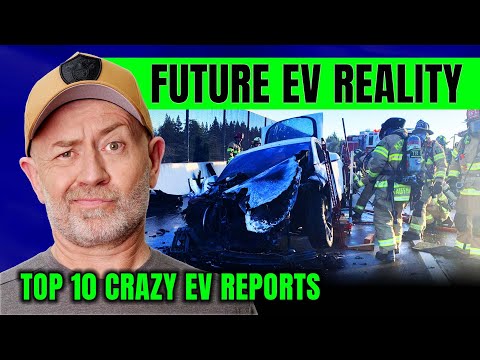
Electric Utopia? Top 10 Insane EV Reports This Month
This report delves into a series of recent, often bizarre, EV developments, highlighting a critical perspective on the industry's progress. The &... morequot;Kratos" electric Jerry can concept is dismissed as impractical marketing "wank," with the reviewer emphasizing its severe limitations in energy capacity and logistical challenges compared to traditional diesel cans. The F-150 Lightning's Australian pricing is scrutinized, revealing a significant "Australia tax." Tesla's recent performance is painted negatively, citing production exceeding sales, a disbanded Supercharger division, and a focus on unproven ventures like robo-taxis and the Optimus robot, all while seeking a massive bonus. The report details dangerous incidents involving the Cybertruck's closing front hatch, resulting in injuries, and the alarming rise in e-mobility fires, particularly in apartment buildings, posing significant safety risks due to poor urban planning. The reviewer concludes by questioning the preparedness for EV-related emergencies and the overall direction of "electric Utopia." less

The Car Industry Is Lying To You Part 2 Feat. Redriven Auto Expert John Cadogan
This podcast episode critically examines the automotive industry's relationship with truth, focusing on misleading Car of the Year awards and the... more inflated cost of parts. John Cadogan, alongside Adam Morris and Jim Hull from ReDriven, argues that awards like the Kia EV9 being named Car of the Year are irrelevant, especially given its $130,000 price point which is out of touch with the financial realities of most families. The discussion highlights how the industry's advertising-driven model compromises journalistic integrity, leading to biased reviews. Furthermore, the episode exposes significant markups on identical parts between different brands (e.g., Lamborghini vs. Volkswagen) and the exorbitant costs associated with minor repairs, such as a fingerprint on a Subaru's camera sensor leading to a $9,600 replacement. The speakers contend that premium badges no longer guarantee superior quality or longevity, with mainstream cars now offering comparable features, and that the focus should shift from brand prestige to practical value and durability. less
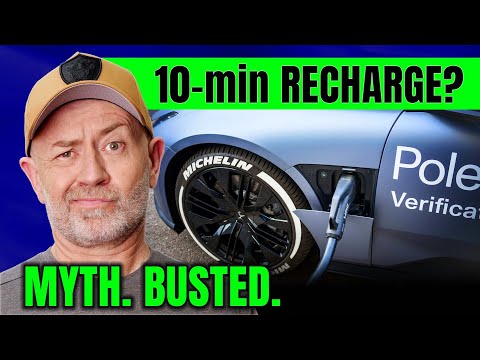
Debunking Polestar's '10-Minute EV Recharge' Claim | Auto Expert John Cadogan
John Cadogan critically examines Polestar's claim of a 10-minute EV recharge, deeming it highly misleading. He argues that charging from 10% to 8... more0% in 10 minutes, as demonstrated on a Polestar 5 prototype with StoreDot's XFC battery technology, is not a full recharge and highlights the unproven nature of StoreDot, a company with a history of unfulfilled commercialization promises. Cadogan emphasizes the significant infrastructure challenges this rapid charging technology would pose at scale, requiring power outputs equivalent to hundreds of homes for just a few vehicles. He questions Polestar's commitment to implementing this technology, noting the lack of concrete rollout plans. Ultimately, Cadogan dismisses the announcement as a 'nothing burger,' suggesting it preys on EV evangelists' confirmation bias rather than offering a practical solution for mass EV adoption. less

10 Reasons Why EVs Can Never Dominate Transportation (Part 2)
In the second part of his critique, John Cadogan presents five more arguments against the widespread adoption of Electric Vehicles (EVs). He begins by... more detailing the significant environmental and economic challenges associated with lithium-ion battery recycling, labeling it a "looming environmental catastrophe" due to its inefficiency and low commercial viability. Cadogan then shifts focus to the serviceability of EV batteries, particularly highlighting Tesla's "structural batteries" as a major flaw, leading to prohibitively expensive replacements and write-offs by insurance companies. He dismisses the notion that the charging infrastructure problem will be solved, emphasizing the immense energy distribution challenges. Furthermore, Cadogan debunks the idea of "new battery technology," asserting that lithium-ion is a mature technology with only incremental improvements possible. Finally, he argues that the current focus on large, expensive EVs represents a "monstrous waste" of resources, suggesting plug-in hybrids or home battery storage as more practical alternatives. The reviewer's overall stance is highly critical, viewing EVs as an inefficient and resource-intensive solution with significant drawbacks. less

10 Reasons Why EVs Can Never Dominate Transportation (Part 1)
John Cadogan presents a critical perspective on the widespread adoption of electric vehicles (EVs), arguing they are unlikely to dominate transportati... moreon. He contends that average consumers are not clamoring for EVs, citing the popularity of traditional 4x4s and SUVs in Australia as evidence. Cadogan also highlights the significant financial losses car manufacturers are incurring by investing heavily in EV production, pointing to Ford, GM, Volkswagen, and Tesla as examples. Furthermore, he questions the environmental effectiveness of EVs, stating that even with 100% EV adoption, transport emissions would only decrease by 10% nationally, and criticizes Australia's government for promoting EVs while being a major exporter of fossil fuels. Cadogan concludes that EVs are generally inferior to combustion engine vehicles in terms of cost, range, battery degradation, and charging time, requiring incentives to sell, unlike superior technologies that gained traction on their own merit. He suggests EVs will remain a niche product for a minority of buyers. less

Tesla Cybertruck Production Is Even Worse Than Anyone Thought
This video critically examines Tesla's Cybertruck production and its broader implications for the company. The primary focus is a recall affectin... moreg nearly 4,000 Cybertrucks due to a potentially jamming accelerator pedal, which the reviewer highlights as a significant design flaw indicative of broader quality issues. The recall data reveals a production rate of approximately 193 units per week, far below Tesla's ambitious targets and capacity, suggesting substantial financial losses due to underutilization of the production line. The reviewer also criticizes Tesla's lack of significant updates for the Model 3 and Model Y, the delayed introduction of a more affordable EV, and the unfulfilled promises of full autonomy and robotaxis. The video concludes that Tesla is struggling to manage its current product line and future ambitions, potentially overstating its technological advancements and market position. less

How Efficient? Recharging EVs with Diesel Generators
John Cadogan critically deconstructs the claim that charging an EV with a diesel generator is more energy-efficient than using diesel in a conventiona... morel vehicle. He meticulously applies thermodynamic principles and real-world calculations, using the Hyundai Ioniq 5 as an example, to demonstrate that this assertion is fundamentally flawed. Cadogan argues that the multiple energy conversion losses—from diesel to AC electricity, AC to DC, and then into the battery, including the energy required for battery cooling systems—render the generator charging method significantly less efficient. He contrasts this with the direct combustion efficiency of a diesel engine in a vehicle. The review highlights the importance of objective engineering reality over ideological 'electric utopian' beliefs, emphasizing that while diesel-electric powertrains are used in heavy machinery for reasons of cost and torque, not efficiency, the EV charging scenario is demonstrably less efficient. Cadogan concludes that the efficiency claims for generator-charging EVs are unsubstantiated and fallacious. less
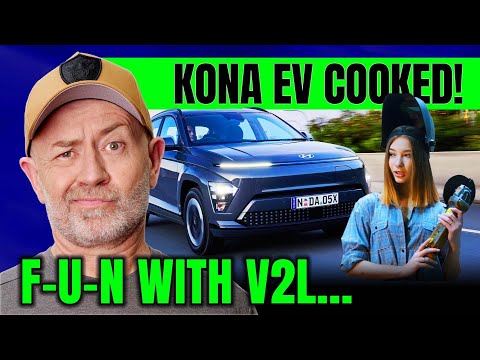
Kona Electric Cooked! Death By V2L, In The Name Of Science
John Cadogan tests the Vehicle-to-Load (V2L) functionality of the Hyundai Kona Electric, with dramatic results. While the car's 230V/15A outlet i... mores theoretically capable of powering household appliances during an outage, Cadogan's attempt to run a 15-amp welder overloaded the system, triggering an 'onboard charger malfunction' error. He discovered that the car's V2L system has a lower surge capacity than the grid, making it susceptible to tripping its internal breaker when powering high-demand devices like welders or even a combination of everyday appliances like a kettle and a fridge kicking in simultaneously. Although the system reset after a reboot, the error message reappeared, necessitating a dealer visit. Cadogan concludes that while V2L is an attractive feature for power outages, users must be mindful of the total power draw, both steady-state and surge, as the car's inverter is less forgiving than the home grid. less

Tesla and Polestar Have Epic Tantrum and Divorce T-Dub
This video critiques the Australian automotive industry's lobbying efforts, particularly focusing on the Federal Chamber of Automotive Industries... more (FCAI) and its boss, Tony Weber (tdub). The reviewer highlights a public spat between the FCAI, Polestar, and Tesla, stemming from proposed fuel efficiency standards. Tesla and Polestar are criticized for their dramatic exits from FCAI discussions, with the reviewer questioning their commitment to genuine environmental action versus self-interest. The Polestar 4 is singled out as an example of an inefficient, heavy EV with questionable environmental credentials, especially when compared to more affordable ICE vehicles like the Hyundai Santa Fe. The video also touches on Volkswagen's history of emissions fraud and Toyota's misleading practices. Ultimately, the reviewer expresses skepticism about the effectiveness of current lobbying groups in addressing climate change, suggesting a reliance on individual action and perhaps even prayer. less

Mitsubishi Ek X: The Ev We Need, But Probably Won't Get
The Mitsubishi eK X EV, referred to as the 'Run' by the reviewer, is presented as the ideal affordable, compact city EV that Australia despe... morerately needs. The reviewer praises its small size, efficiency, and surprisingly good safety credentials, citing a 5-star JNCP rating. However, the core of the review focuses on why this vehicle is unlikely to be sold in Australia. The primary obstacle identified is ANCAP's safety rating system, which mandates the inclusion of Advanced Driver Assistance Systems (ADAS). The reviewer argues that these systems are often poorly implemented, overly intrusive, and do not demonstrably improve safety, instead making driving more distracting and annoying. The cost of adding these mandated ADAS features would inflate the eK X's price significantly, rendering it uncompetitive. The reviewer criticizes ANCAP for its perceived misuse of public funds and its reliance on overseas testing, ultimately concluding that the current safety rating system hinders the introduction of genuinely useful and affordable EVs like the eK X. less