
Auto Expert John Cadogan positions itself as a vital resource for navigating the complexities of the automotive world, particularly within the highly competitive Australian market. The channel delves into the everyday realities of car ownership, addressing common frustrations and offering insights into the decision-making processes behind purchasing and maintaining vehicles. It aims to demystify the automotive landscape for consumers, providing expert guidance on a range of topics.
With a focus on practical advice and in-depth analysis, Auto Expert John Cadogan covers essential aspects of vehicle ownership, from the nuances of upgrading older cars to the critical factors influencing tyre performance and safety. The channel also engages with contemporary issues such as electric vehicle (EV) technology, exploring both the potential and the challenges associated with their widespread adoption and integration into existing infrastructure.
With a focus on practical advice and in-depth analysis, Auto Expert John Cadogan covers essential aspects of vehicle ownership, from the nuances of upgrading older cars to the critical factors influencing tyre performance and safety. The channel also engages with contemporary issues such as electric vehicle (EV) technology, exploring both the potential and the challenges associated with their widespread adoption and integration into existing infrastructure.

When Should I Upgrade My Old Car? | Auto Expert John Cadogan
John Cadogan tackles the perennial question of when to upgrade a vehicle, offering a pragmatic perspective that challenges the industry's push for constant turnover. He argues that keeping a car longer significantly reduces depreciation and environmental impact, directly refuting the "greenwashin...



Latest Additions
Showing 24 of 285 total titles. Page 5 of 12.

Toyota BZ4X EV Will Be a Depreciation Disaster
John Cadogan delivers a scathing review of the Toyota BZ4X, labeling it a 'depreciation disaster' and one of the 'world's worst EV... mores'. He criticizes Toyota's apparent reluctance to embrace EVs, highlighting the BZ4X's significant delays and a critical design flaw that led to wheels detaching. Cadogan dismisses the company's explanations as 'perception bending' and criticizes the automotive media for not holding Toyota accountable. He finds Toyota's new lease offer, which allows customers to pay off the depreciation incrementally, to be a way to 'bend you over' without the immediate shock of a trade-in value collapse. The review concludes that the BZ4X is a poorly engineered vehicle with a dismal future resale value, and the lease deal is merely a way to mask this inevitable financial loss for the consumer. less

Kia EV9: Worst Possible Car of the Year
John Cadogan delivers a scathing critique of the Kia EV9, labeling it 'morbidly obese' and an 'insult to fundamental engineering concep... morets.' He vehemently disagrees with Drive.com.au's 'Car of the Year' award, particularly for the 'poverty pack' EV9 Air, deeming it an 'epic Car of the Year dud call.' Cadogan questions the environmental credentials of the EV9, arguing that its massive battery and weight, coupled with charging from coal-fired power grids, result in significant CO2 emissions comparable to or worse than a diesel Kia Sorento. He highlights the impracticality of long charging times and the high cost of ownership, including expensive tire replacements. The reviewer criticizes the award's justification, citing inconsistencies in Drive's past statements about hybrids versus EVs and questioning the publication's methodology and understanding of the Australian market. Ultimately, Cadogan suggests the EV9 is an expensive, inefficient, and environmentally questionable choice, questioning its role as a 'game changer' for Australian families. less

Polestar EVs: Too Expensive to Own, Says Hertz CEO
The Hertz CEO's decision to significantly reduce its EV fleet, including backing out of a large Polestar order, highlights a critical issue: the ... morehigh cost of EV ownership and operation. The reviewer argues that despite the enthusiasm of EV evangelists, the financial realities are proving detrimental, with Hertz finding both Tesla and Polestar ownership prohibitively expensive. This move by Hertz, a major fleet operator, serves as a cautionary tale for individual consumers, suggesting that EV ownership is currently a financially unsound decision. The report also touches on the struggles of Polestar, a company teetering on the brink of bankruptcy, and its reliance on large orders like Hertz's for survival. The reviewer criticizes Polestar's sales tactics in Australia as a 'prick tease' rather than genuine sales, given the long wait times and uncertain pricing. Ultimately, the video concludes that the high cost of EVs is the fundamental problem, making them an objectively poor financial choice for most consumers. less

New Polestar 4: Another Pointless, Overweight EV
John Cadogan delivers a scathing critique of the Polestar 4, labeling it a "pointless, overweight EV" and a "massive waste of the Earth... more's resources." He highlights the vehicle's significant weight, comparing it unfavorably to a Ford Ranger Wildtrak, and questions its environmental credentials given the manufacturing CO2 emissions and the large 100 kWh battery. Cadogan criticizes Polestar's marketing, particularly the "now on sale" claims when deliveries are months away. He dismisses the "SUV Coupe" description as derivative and mocks the use of recycled materials and "Animal Welfare Nappa leather." The reviewer concludes that the Polestar 4, like other large EVs, offers no genuine environmental benefit over comparable combustion engine vehicles and represents a "virtue mobile" for those detached from reality. His overall verdict is that purchasing such a vehicle is a "greater mistake" than significant personal blunders. less
EV Fast Charger Companies Are Collapsing!
The video critically examines the financial struggles of major EV fast charging companies, specifically ChargePoint and Tritium, highlighting their re... morecent operational withdrawals and significant stock value declines. The presenter, John Cadogan, expresses a lack of sympathy for these companies, labeling them as "losers" and criticizing their reliance on government support and "green virtue." He points out the immense capital costs and logistical challenges of scaling fast-charging infrastructure, suggesting that the "electric Utopia" is a "scam" that fails to account for real-world economic and infrastructural realities. The review also touches upon the rising costs for consumers using EV charging networks, making them potentially more expensive than gasoline for equivalent travel. Cadogan's overall verdict is that the current model for EV fast charging is commercially unviable without substantial, unsustainable government subsidies, leading to a "panic struck retreat" rather than a planned transition. less

Recharging an Electric Vehicle Now Costs More Than Petrol
John Cadogan delivers a scathing critique of the current state of electric vehicle charging infrastructure and ownership costs in Australia. He highli... moreghts that public DC fast charging, specifically from EVie, has surpassed petrol prices per kilometer, making it more expensive than driving a comparable internal combustion engine vehicle like the Mazda 3. Cadogan argues that this situation is particularly detrimental to urban dwellers without off-street parking, who are forced to rely on expensive public charging. He criticizes the justifications provided by charging operators and expresses concern over the potential for exploitation. While acknowledging the benefits of EVs in reducing local air pollution and bolstering energy security, Cadogan strongly condemns the "cult-like" evangelism surrounding them and the misinformation propagated by proponents. He emphasizes that the upfront cost, depreciation, insurance, and battery replacement remain significant drawbacks, and the idea of EVs being maintenance-free is a myth. The review concludes by questioning the financial viability of EV ownership, especially for those reliant on public charging, and predicts that the $1 per kilowatt-hour charging barrier is imminent. less
London E-Bus Blaze Proves Electric Buses Are A Joke
John Cadogan delivers a scathing critique of electric buses, using a recent London fire incident as a focal point. He argues that the push for electri... morec public transport, driven by what he terms 'green zealots,' prioritizes virtue signaling over public safety and practical implementation. Cadogan highlights numerous instances of electric bus failures, including fires, range issues in cold weather, and poor reliability, citing examples from London, Australia, and various North American cities. He contrasts these failures with the perceived reliability and lower cost of diesel buses, suggesting that the current transition to electric fleets is a dangerous, ill-conceived experiment on society. The review concludes that while electric transportation has a place, its current implementation, particularly for mass transit, is flawed, costly, and poses significant risks, with the potential for long-term health consequences from hazardous materials released during fires. less

Tesla Cybertruck: A Crash Test Death Trap
This report critically examines the Tesla Cybertruck, retracting previous criticisms and focusing on a concerning crash test analysis. The reviewer, J... moreohn Cadogan, initially apologized for calling the Cybertruck names like 'cyber urinal' and 'cyber trough,' admitting it was a mistake. However, new information, primarily from a crash test comparison video by YouTuber 'VoiceOfThunder' (Philip E. Mason), leads to a starkly different conclusion. The analysis, based on overlaying official crash footage of a Ford F-150 and the Cybertruck, suggests the Cybertruck's rigid structure, while potentially offering a perception of strength, results in a significantly shorter stopping distance for the dummy's head. Applying Newtonian physics, Cadogan argues this shorter distance translates to higher impact forces on the occupant, making the F-150, which allows for greater head travel and thus lower forces, the safer vehicle in a 35 mph frontal crash. The reviewer concludes that for survival, one would prefer to be in an F-150 during such an impact, dubbing the Cybertruck a 'cyber coffin.' less
Chinese SUV Passes Absurd ANCAP 'Submarine' Test
John Cadogan delivers a scathing critique of ANCAP's safety rating system, using the Chery Tiggo 7 Pro as a prime example. While the SUV achieves... more a five-star rating, Cadogan highlights significant flaws, particularly its 'marginal' performance in automatic emergency braking and emergency lane keeping assistance, and a 'poor' rating for driver's chest injury likelihood in critical crash tests. He argues that ANCAP's focus on the absurd 'submarine' test, which assesses underwater egress capability, detracts from more relevant safety concerns like rollover protection. Cadogan finds the inclusion of the hammer for breaking windows in emergencies to be a desperate attempt to add value to a fundamentally flawed rating system, questioning the real-world relevance and frequency of such drowning scenarios. His verdict is that ANCAP's five-star rating has become largely meaningless due to its emasculated context and taxpayer-funded absurdity. less

Tesla Cybertruck Has A Massive Battery Problem
John Cadogan delivers a scathing critique of the Tesla Cybertruck, focusing heavily on the purported "massive battery problem." He asserts t... morehat Tesla, and specifically Elon Musk, has failed to master the production of the new 4680 battery cells using the "dry coating" process, which is crucial for scaling production and reducing costs. Cadogan cites a Reuters report, based on interviews with anonymous sources, suggesting that Tesla is struggling significantly with this technology, particularly for the cathode. This bottleneck, he argues, is the primary reason for the Cybertruck's significant delays and its current limited production volume, far below initial promises. He dismisses the launch as a "PR scam" and labels the batteries in existing vehicles as "experimental." The review highlights the discrepancy between Musk's ambitious claims and the reported manufacturing realities, questioning the feasibility of future Tesla models relying on these unproven battery technologies. Cadogan concludes that the Cybertruck's production is severely hampered by these battery issues, leading to a vehicle that is late, expensive, and potentially unreliable due to unproven technology. less

Massive EV Cement Truck Fire: Official Explanation Versus The Facts
This video critically examines the official explanation of a significant EV cement truck fire on Melbourne's West Gate Freeway, attributing the i... morencident to a single cell failure. The reviewer, John Cadogan, vehemently disputes this, arguing it was a catastrophic chain reaction of thermal runaway. He criticizes Janus Electric for deploying a hazardous product without adequate testing, highlighting that the company had data indicating cell issues for weeks prior but failed to act. Cadogan emphasizes the extreme toxicity and danger of EV fires compared to conventional truck fires, citing firefighter injuries and the inability to extinguish such blazes. He dismisses the company's claims of safety and statistical rarity, presenting data that suggests Janus trucks may be significantly more prone to fires than traditional trucks. The review concludes that deploying these vehicles without proper R&D turns public roads into a hazardous laboratory, a practice he deems unacceptable and enabled by government incentives. less

How Does Plug-In Hybrid (PHEV) Technology Really Work?
This in-depth interview with Mitsubishi engineer Tim Clark provides a comprehensive technical breakdown of plug-in hybrid (PHEV) technology, focusing ... moreon the Mitsubishi Outlander PHEV. The discussion clarifies the complex series and parallel operating modes, emphasizing that below 70 km/h, only electric motors drive the wheels, while the internal combustion engine primarily acts as a generator or provides direct drive to the front wheels at higher speeds via a hydraulic clutch. The review highlights the vehicle's impressive off-road capability, particularly its electric all-wheel-drive system with torque vectoring, which allows for confident crawling over challenging terrain, a surprising revelation for many. While the lack of a spare tire is noted as a compromise for battery packaging, the video suggests aftermarket solutions and emphasizes the vehicle's versatility as both a capable city commuter and a long-distance hybrid. The expert debunks common misconceptions about PHEV usage, stressing that regular charging is crucial for optimal efficiency and benefits. The discussion also touches upon battery degradation, charging infrastructure, and the high-voltage system's safety and servicing requirements, concluding that the Outlander PHEV offers a compelling blend of electric efficiency and hybrid range, making it a strong contender for family adventures. less

Do Not Buy An EV Without Watching This Reality Check
This video presents a stark reality check for potential EV buyers in Australia, particularly those considering regional travel. The reviewer highlight... mores a real-world road trip experience where charging costs were 50% higher than petrol for a comparable internal combustion engine car, and the journey took 25% longer due to extensive recharging. Significant issues were raised regarding the charging infrastructure, including the need for multiple apps, poor network coverage hindering charger access, and a general lack of security at remote charging stations, especially for solo travelers. The reviewer also debunks the myth of increased range on highways for EVs, stating they are less efficient on open roads than in city traffic, leading to range anxiety. While acknowledging the existence of use cases for EVs, the video strongly advises against purchasing one if regional travel is a consideration, emphasizing that the current infrastructure and user experience do not align with the fantasy of 'free-range' EV ownership outside of urban centers. less

Elon Musk Fails Cybertruck Stainless Steel Metallurgy Test
John Cadogan critically analyzes Elon Musk's claims regarding the Tesla Cybertruck's stainless steel exoskeleton. Cadogan debunks the assert... moreion that the unique angular design is necessary to avoid breaking stamping presses, explaining that 300-grade stainless steel, while workable, has limitations. He highlights that the material's hardness is often overstated, comparing it unfavorably to common tools and noting it can be scratched by a scouring pad. Cadogan clarifies that while the steel is tough and bullet-resistant (a largely irrelevant attribute for a vehicle), its tensile strength is significantly lower than the advanced high-strength steels (AHSS) used in conventional cars, some of which are twice as strong. He concludes that the Cybertruck's aesthetic is dictated by the material's forming limitations rather than press durability, and that its choice results in a vehicle prone to scratching, with potentially high repair and insurance costs, and objectively inferior strength compared to mainstream vehicles. less
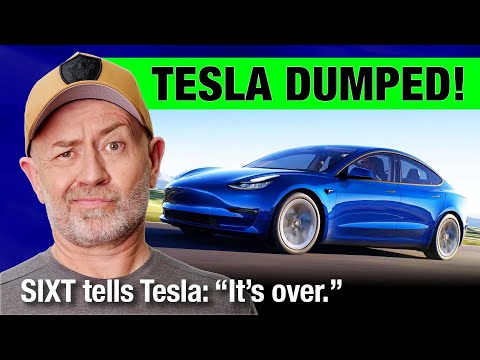
Car Rental Giant Sixt Declares Tesla Too Expensive to Own and Run
Car rental giant SIXT has officially declared Tesla vehicles too expensive to own and operate, citing high depreciation and exorbitant running costs. ... moreThis decision validates Hertz's earlier stance, highlighting a significant financial challenge for fleet operators. The reviewer criticizes Tesla's "crackpot claims" regarding the Cybertruck's capabilities on other planets, deeming them predatory and aimed at wealthy, easily misled buyers. The video also touches on aftermarket accessories for the Cybertruck, likening it to a "dystopian masturbatory fantasy." Furthermore, a recent electric truck fire in Melbourne is discussed, attributing it to a likely failure in the battery's cooling system, possibly due to an air-cooling design being insufficient for the demands of heavy-duty use, leading to thermal runaway. The overall sentiment is critical of Tesla's business practices and the practical viability of its electric vehicles in certain commercial applications. less
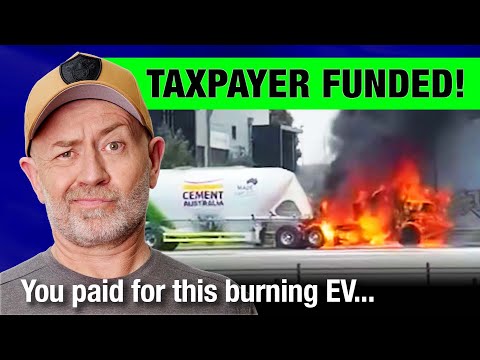
Massive EV Truck Blaze Was Taxpayer-Funded. You Paid For This.
This report details a significant incident involving a taxpayer-funded electric Kenworth prime mover operated by Cement Australia, which caught fire o... moren a Melbourne freeway. The reviewer, John Cadogan, strongly criticizes the event as a "dodgy EV conversion" and a "greenwashing scam," highlighting that public funds were used for this "rolling Hazmat disaster." He provides multiple pieces of evidence, including the truck's green livery, visible "electric vehicle" text, aggressive horizontal flames indicative of battery fires, and the absence of diesel exhaust stacks, to confirm it was an electric vehicle. Cadogan condemns the public testing of such potentially unsafe technology, comparing it to testing a new aircraft with passengers. He also criticizes the government's focus on EV initiatives while neglecting older, more polluting diesel trucks. The review concludes by questioning the integrity of sponsored content and the overall viability and safety of current EV conversion technology, particularly from companies like J an us (Janus), which has experienced previous incidents. less

Tesla Cybertruck's Top 12 Failures
John Cadogan delivers a scathing critique of the Tesla Cybertruck, labeling it a "heap of crap" and an "abject failure" across 12 ... morekey points. He highlights significant discrepancies between Elon Musk's initial promises and the final product, particularly concerning the price, which has ballooned from an advertised $40,000 to nearly $100,000. Cadogan criticizes the vehicle's excessive size and weight, its impractical cargo bay, and a "ridiculous" battery size that necessitates extremely long charging times. He also dismisses the much-touted "bulletproof" feature as impractical and potentially dangerous. Furthermore, the reviewer argues the Cybertruck is a financial liability for Tesla, a "PR stunt" rather than a genuine product rollout, and a reputational risk due to unmet expectations. The range is also a major disappointment, falling short of the promised 500 miles. Cadogan concludes that the Cybertruck's only potential success lies in its appeal to a specific demographic seeking external validation through ostentatious possessions, rather than any inherent merit as a functional vehicle or a sound investment. less

Mitsubishi Outlander PHEV: Torture Tested in the Flinders Ranges
John Cadogan subjects the Mitsubishi Outlander PHEV to an extreme test in the Flinders Ranges, challenging its "rugged ready" claim, particu... morelarly its lack of a spare tire. While acknowledging the vehicle's excellent city performance and sophisticated electric AWD system, Cadogan highlights the significant modifications required for serious Outback touring, including the need for aftermarket spare tire storage, a proper jack, and potentially all-terrain tires. He praises the electric drivetrain's torque and control in off-road scenarios, noting its surprising capability on rough tracks, but cautions that it's not a replacement for a hardcore 4x4. The review concludes that while the Outlander PHEV isn't "rugged ready" out of the box, its platform is robust and can be adapted for family-level adventuring, offering a superior on-road experience compared to heavily modified off-road vehicles. less

Massive EV Truck Fire On Freeway Puts Thousands At Risk
The video details a catastrophic fire involving an independently converted electric Kenworth cement truck on a Melbourne freeway. The reviewer, John C... moreadogan, expresses strong skepticism about the viability and safety of electric heavy-duty trucks, particularly in the context of cement production. He highlights the incident as a significant failure, questioning the 'Net Zero' ambitions for cement production, which he deems unrealistic and a form of 'greenwashing.' Cadogan criticizes the reliance on electric trucks as a solution, pointing to the truck's fire as evidence of inherent risks and engineering challenges. He advocates for improving the efficiency of existing diesel technology and minimizing waste in cement production rather than pursuing unproven electric solutions. The review concludes that electric trucks are not a tangible solution for the cement industry's emissions and that the incident serves as a public display of the underlying 'greenwashing scam.' less

The Killer EV Design Deficiency Nobody Talks About
This video delves into a critical, yet often overlooked, design flaw in certain electric and plug-in hybrid vehicles: the potential for passenger comp... moreartment explosions due to battery thermal runaway. The host highlights incidents involving the Jeep Wrangler 4xe and Renault Zoe EV, where the design seemingly allows toxic, explosive gases to accumulate, leading to violent deflagration events. The review strongly criticizes manufacturers for placing battery enclosures within the passenger compartment, citing a lack of a proper floor in the Wrangler and direct access for off-gassing in the Zoe. The expert emphasizes that while EV fires might be statistically less frequent than internal combustion engine fires, the consequences of a thermal runaway event, particularly the toxic gas accumulation, pose a severe and immediate threat to occupants, potentially incapacitating them before an explosion even occurs. The video advocates for a simple design fix: physically separating the battery from the passenger compartment with adequate insulation. The reviewer praises Captain Patrick Durham for his technical analysis and straightforward reporting on the issue, contrasting it with what he perceives as overly optimistic rhetoric from electrification advocates. less

Reacting to Your Recent EV Feedback and Criticism (S2 E10) | Auto Expert John Cadogan
John Cadogan's latest episode tackles viewer feedback, focusing heavily on the perceived inefficiencies and risks associated with electric vehicl... morees, particularly the Kia EV9. While the video is framed as a response to criticism, it largely reinforces a skeptical stance towards EVs. Cadogan dismisses rapid charging claims, arguing that waste heat and battery limitations prevent the advertised speeds. He also strongly refutes the idea that EVs are inherently safer than internal combustion engine (ICE) vehicles, highlighting the severe risks posed by lithium-ion battery fires, their toxicity, and the lack of effective firefighting techniques. The review also touches on the impracticality of charging EVs via diesel generators and the extreme effort required for pedal-powered charging, contrasting these with the convenience of hydrocarbons. While acknowledging the EV9's weight and inefficiency, Cadogan's overall tone suggests a preference for the established convenience and perceived lower risks of ICE vehicles, despite their own environmental and safety drawbacks. less
Why EV Utopia Has Become a Living Hell For Carmakers and EV Owners
John Cadogan delivers a scathing critique of the current state of the electric vehicle transition, arguing that the promised 'utopia' has be... morecome a 'living hell' for both manufacturers and owners. He highlights significant financial struggles for major automakers like Volkswagen, Tesla, General Motors, and Ford, citing massive investments yielding little profit, the impact of subsidy withdrawals, and the unsustainable cost of EV production and repair. Cadogan also points to critical supply chain issues with raw materials for batteries and the looming environmental disaster of battery disposal due to a lack of recycling infrastructure. Furthermore, he questions the promised advancements in battery technology, noting only incremental improvements and significant safety concerns. The review concludes that the perceived benefits of EVs do not yet outweigh the substantial 'broken eggs' – the financial, environmental, and practical challenges – leaving the ultimate 'omelet' of a successful EV future uncertain. less

Polestar's Worst Idea Yet? It's Magic
John Cadogan critically examines Polestar's partnership with StoreDot, a company promising revolutionary extreme fast charging (XFC) technology. ... moreWhile Polestar touts the ability to add 160 km of range in just 5 minutes, Cadogan expresses deep skepticism. He highlights the severe limitations of current charging infrastructure, noting that no chargers in Australia can support the required 450 kW. Furthermore, he raises significant concerns about the detrimental effects of such rapid charging on battery longevity and the immense heat generated, potentially leading to thermal runaway. Cadogan delves into StoreDot's history, pointing to a decade of unfulfilled promises and unreleased products, likening their current claims to previous fantastical technological predictions. He concludes that the partnership is a "spectacular non-achievement" and a "total load of irrelevant horses ," urging a more grounded approach to EV technology and critical thinking. less
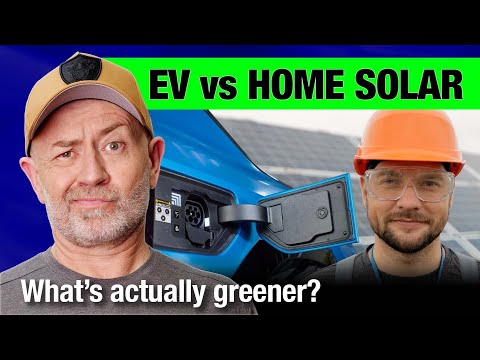
EV Versus Rooftop Home Solar: What's Actually Greener?
John Cadogan critically examines the environmental claims of electric vehicles (EVs), arguing that many large, premium EVs with oversized batteries ar... moree not as "green" as advertised. He contends that the manufacturing process for these massive batteries has a significant carbon footprint, often taking years to offset through driving, especially if charged with non-renewable electricity. Cadogan contrasts this with purchasing a more economical diesel SUV and investing in a home solar system with a battery, such as the Bluetti EP760. He calculates that this approach can be both cheaper upfront and greener in the long run, achieving CO2 breakeven much faster than with a large EV. The review highlights the financial savings and environmental benefits of a smaller-scale, home-based renewable energy solution over the perceived "virtue signaling" of expensive, large-battery EVs, labeling the latter as a "climate action scam." less