
Out of Spec Testing specializes in rigorous, repeatable evaluations of electric vehicles, delving deep into their capabilities and limitations. This channel is dedicated to providing comprehensive insights through a variety of challenges, including extensive range tests, detailed charging analyses, and realistic road trip simulations. Viewers can expect thorough assessments of advanced driver-assistance systems (ADAS) and other critical performance metrics.
The content meticulously examines electric cars across diverse scenarios, featuring head-to-head comparisons and real-world performance data. From highway range tests pushed to their limits to simulated long-distance journeys and cutting-edge charging technology assessments, Out of Spec Testing offers an authoritative perspective for electric vehicle enthusiasts seeking in-depth, data-driven reviews.
The content meticulously examines electric cars across diverse scenarios, featuring head-to-head comparisons and real-world performance data. From highway range tests pushed to their limits to simulated long-distance journeys and cutting-edge charging technology assessments, Out of Spec Testing offers an authoritative perspective for electric vehicle enthusiasts seeking in-depth, data-driven reviews.

Volkswagen ID. Buzz AWD 70-MPH Highway Range Test Driven Until It Dies
The Volkswagen ID. Buzz First Edition 4MOTION delivers a unique and characterful driving experience, though its highway range is a significant point of contention. While the vehicle excels in urban environments and offers a fun, nostalgic aesthetic, its highway range test at 70 mph yielded a disa...


Latest Additions
Showing 24 of 57 total titles. Page 1 of 3.

Tesla Model Y Standard Performance Tested - Our First Go At Acceleration / Braking Benchmarking
This video introduces Out of Spec's new performance benchmarking tests, starting with the Tesla Model Y Standard RWD. The reviewer focuses on est... moreablishing repeatable acceleration and braking tests, opting for a "no prep" surface and "no rollout" for acceleration to ensure consistency. While the Model Y Standard is noted as the slowest in Tesla's lineup, with a manufacturer-claimed 0-60 mph in 6.8 seconds and mid-200s horsepower, the testing revealed a 0-60 mph time of 6.77 seconds on the first run, improving to 6.72 seconds on subsequent attempts. The reviewer highlights that the car feels slow off the line (poor 60-foot times) but accelerates strongly from around 40-50 mph, with the 50-90 mph test taking 5.75 seconds. Braking from 60-0 mph was achieved in 117 feet, attributed to tire adhesion and ABS tuning rather than brake system thermal performance. The reviewer expresses dissatisfaction with the Model Y Standard's value proposition, citing its stripped-down interior and lack of ambient lighting, despite its efficiency and handling capabilities. The video also introduces the Draggy Pro as a new testing tool and discusses the methodology for future comparative tests. less

Driving Tesla Model X Until It Runs Out Of Charge! Tesla Put So Much Juice Below 0%
The 2025 Tesla Model X Long Range Dual Motor undergoes an extreme 'Run to Zero' test, revealing a surprisingly large buffer below 0% charge.... more The reviewer was astonished by the vehicle's ability to continue driving for over 26 miles and 7.2 kWh beyond the indicated 0% charge, deeming this buffer 'unacceptable' as it deprives users of usable range. Despite initial concerns about reliability due to prior suspension, HVAC, and driver assistance issues, the car performed consistently during the test, with only minor warnings appearing as the battery depleted. A notable observation was the slow initial charging rate when depleted, with a significant portion of the incoming power directed to the heat pump rather than the battery. The reviewer concludes that Teslas, particularly this 'P3 generation' Model X, offer a substantial, albeit potentially misleading, reserve of energy below the 0% mark. less

Ford F-150 Lightning Standard Range European Spec 0-100% DC Fast Charging Test
This video thoroughly tests the DC fast charging capabilities of the European-spec Ford F-150 Lightning Standard Range. The reviewer highlights the ve... morehicle's unique charging curve, starting with an initial boost to around 150 kW, followed by several dips and a significant drop to 44 kW at 80%. The most disappointing aspect is the extremely slow charging speed from 80% onwards, tapering down to Level 2 speeds (around 22 kW and below) by 90%, and continuing at very low rates until 100%. The reviewer notes that this slow end-charge is a drawback, especially for a vehicle where maximizing range is crucial. Despite this, the reviewer praises the F-150 Lightning as a great truck overall, popular in Norway, and acknowledges that for many users, especially those with farm or local use, the charging performance is adequate. However, for longer trips, a faster charging curve would be highly desirable, especially considering the vehicle's 2021 release date. less

Volkswagen ID. Buzz Road Trip 10% Challenge! It's Not As Bad As You Think
The Volkswagen ID. Buzz AWD, equipped with the 91kWh gross battery, was subjected to the 10% challenge road trip simulation. Despite initial concerns ... moreabout its battery size and charging speed, the ID. Buzz performed surprisingly well in the 15-minute charging session, delivering 43.16 kWh and achieving a peak charging rate close to 200 kW. The reviewer highlighted the vehicle's excellent top-charging capability, which helps mitigate its overall efficiency limitations. In the road test, the ID. Buzz covered 71.5 miles at an average of 1.8 miles per kWh, a result that places it competitively with vehicles like Rivians and Rons in a charger-hopping scenario. While acknowledging the vehicle's high price point and the expectation for faster charging and greater range, the reviewer concluded that the ID. Buzz is a capable road trip companion, especially when driven at slightly lower speeds, and offers a unique, enjoyable driving experience that appeals to emotional rather than purely rational purchasing decisions. less

Driving The Lucid Gravity All The Way Until It Dies! Huge Buffer Below 0% In Our Run To Zero Test
In this "Run to Zero" test, the Lucid Gravity Grand Touring was driven until it completely stopped, revealing a significant buffer below 0% ... morestate of charge. The reviewer found the extensive reserve range (over 6 kWh and 22 miles past 0%) to be excessive, arguing it deprives users of usable energy and highlights potential inaccuracies in the Battery Management System (BMS) after repeated charge/discharge cycles. Despite this, the driving experience itself was praised, with the reviewer highlighting the car's quietness, handling, rear-steer capability, and world-class chassis and suspension tuning. The test also noted that climate control is disabled at 0%, and while the car eventually entered "turtle mode" with reduced performance, it continued to provide usable power for an extended period. The primary concern remains the BMS calibration issue, which Lucid is reportedly aware of and working to fix. less

New Nordic 10% Challenge! Tesla Model Y vs XPENG G6 vs Skoda Enyaq Coupe RS
This video presents a novel "10% Challenge" road trip simulation adapted for Norway, focusing on how far cars can travel on energy added dur... moreing a 15-minute charging stop. The Skoda Enyaq Coupe RS, despite initial skepticism from the reviewer, proved to be a surprisingly capable road tripper, achieving an impressive 162 km. This performance surpassed the Tesla Model Y's 147.6 km in this specific test, largely due to the Skoda's superior charging speed and flatter charging curve, which allowed it to add more usable energy in the allotted 15 minutes. The reviewer highlights the Enyaq's comfortable highway driving experience, effective lane-holding system, and premium interior feel. However, the XPENG G6 emerged as the clear winner, covering an astonishing 248.8 km, demonstrating exceptional charging capabilities that significantly outperform both the Skoda and Tesla in this road trip scenario. The video concludes that while efficiency is important, the charging speed and energy added in a short time are critical factors for real-world road trip performance. less

I Drive The VW ID. Buzz Until It Runs Out Of Charge! Perfect Run To Zero Performance
In this 'Run to Zero' test, the Volkswagen ID. Buzz Long Wheelbase AWD demonstrates impressive German engineering by providing usable power ... moreeven at extremely low states of charge. The reviewer highlights that the vehicle remains highway capable down to 1% and even below, offering 'juice all the way at the bottom of the pack.' A key takeaway is the vehicle's predictable behavior as it approaches and goes below 0%, with clear warnings and a 'maneuvering possible' mode that allows for safe movement off the road. The reviewer praises the ID. Buzz for its intentional and safe approach to battery management, including two restarts after hitting zero, which is seen as a significant improvement and a solid result for the test. While acknowledging the vehicle's high price and modest range, the reviewer expresses a positive overall impression, particularly appreciating the usable power delivery and the car's resilience during extreme testing. less
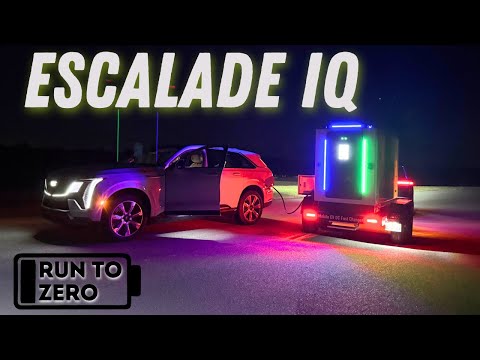
I Run The Electric Escalade IQ Out Of Juice To See What Happens! Our First Run To Zero Failure
The Cadillac Escalade IQ's 'Run to Zero' test revealed significant performance degradation at low states of charge, a critical finding ... morefor potential buyers. While the vehicle boasts a large battery capacity (estimated at 215-219 kWh), its ability to maintain highway speeds or even moderate acceleration diminishes drastically below 4% state of charge. The reviewer noted the car became "dangerously too slow" for highway merging and struggled to reach 55 mph even at full throttle. A major concern is that the Escalade IQ died completely at 1% state of charge, failing the test's criteria of reaching 0%. This premature failure, despite the BMS indicating remaining charge, suggests potential BMS confusion or a weak cell issue. While the 2026 model year appears to have fixed the restart issue after a complete shutdown (unlike previous GM models), the severe performance drop and early failure are significant drawbacks. The reviewer advises treating 5% state of charge as the effective 'zero' for highway-capable driving. less

Lucid Gravity Touring (89kWh) 0-100% DC Fast Charging Analysis
This video provides a detailed analysis of the Lucid Gravity Touring's DC fast charging capabilities, specifically focusing on a 0-100% charge cy... morecle. The content centers around Out of Spec Testing's methodology and results, with Kyle at the helm. While the transcript is empty, the title and description indicate the core subject is the charging performance of the 89kWh Lucid Gravity Touring model. The video aims to deliver factual data on charging speeds and efficiency for potential buyers. less

10% Challenge Viewer Submission Tesla Model Y Dual Motor LG Pack Road Trip Simulation
This video documents a viewer's "10% Challenge" road trip simulation in his 2024 Tesla Model Y Long Range Dual-Motor. The test aims to ... morereplicate real-world road trip conditions by charging for 15 minutes at a 10% state of charge and measuring the distance traveled until the next 10% state of charge is reached. The reviewer successfully completed the challenge, achieving 100.4 miles of travel at an average speed of 80 mph under favorable weather conditions (low 70s Fahrenheit). The reviewer highlights the Model Y's capability for long-distance travel, stating that with a 15-minute charge, an additional 100 miles can be added, making extended road trips feasible and enjoyable. The car, nearly two years old with 20,000 miles, demonstrated impressive range and charging performance, reinforcing the practicality of EVs for road trips. The reviewer concludes that the Model Y is a pleasure to drive and that charging does not significantly impede long journeys. less

Lucid Air Sapphire 10% Road Trip Challenge! The New North Carolina Loop Is Amazing
The Lucid Air Sapphire undergoes the 10% road trip challenge, aiming to quantify its long-distance capability beyond its track-focused performance. Th... moree test involves charging for 15 minutes and then driving at 80 mph until the battery reaches 10% again. The reviewer highlights the Sapphire's impressive charging speed, peaking at over 300 kW, and its luxurious, quiet, and comfortable ride, complemented by decent driver assistance features. However, the vehicle's efficiency at 80 mph is noted as a drawback, achieving 2.56 miles per kWh and covering 126 miles. While this is considered an acceptable road trip range, it falls short of expectations for a Lucid product and is less efficient than some competitors. The reviewer suggests that a Grand Touring trim would likely perform better in terms of efficiency and range. Despite the efficiency concerns, the Sapphire is praised for its overall road trip suitability, especially with the new, ideal testing loop in North Carolina. less

Lucid Air Sapphire 70-MPH Highway Range Test
The Lucid Air Sapphire's 70 mph highway range test yielded a disappointing 337.3 miles, significantly short of its 427-mile EPA rating. While the... more reviewer praised the car's comfortable ride, quiet cabin, and advanced driver assistance systems, the efficiency, averaging around 3 miles per kWh, was a major letdown. The reviewer speculated that battery degradation from previous track use or consistent charging at 100% might be contributing factors, though the battery health seemed robust. Despite the range shortfall, the Sapphire's performance and handling were highlighted, but for long-distance cruising, the Grand Touring model appears to be a more efficient choice based on previous tests. The inclusion of aero wheel covers was noted as a standard feature that likely aids efficiency, though a direct comparison test was not performed. less

Highway Range Test: Rivian R1S Dual Max vs Mercedes G580e vs Hummer EV
This video pits three electric adventure SUVs against each other in a 70 mph highway range test: the Rivian R1S Dual Max, Mercedes G580e (EQG), and Hu... moremmer EV. The Rivian R1S, despite its EPA rating of 410 miles, struggled to meet expectations, with the reviewer predicting it wouldn't hit 400 miles on the highway due to optimizations for EPA cycles rather than real-world highway driving. The Mercedes G580e, with an EPA rating of 239 miles, surprisingly outperformed its estimate, with the reviewer anticipating it would exceed 250 miles. The Hummer EV, rated at 313 miles, was expected to be closer to its EPA figure. The test highlights the significant differences in real-world highway efficiency compared to EPA estimates, with the G-Class proving more efficient than the Hummer, and the Rivian falling short of its potential. The G-Class's efficiency was noted as being around 2 miles per kWh, while the Hummer was consistently around 1.6 miles per kWh. The Rivian's efficiency varied, starting around 1.72 miles per kWh and improving to over 3 miles per kWh on the return leg. The Mercedes G580e ultimately ran out of charge first, followed by the Rivian R1S, with the Hummer EV being the last to deplete its battery. less

Supercruise Is Much Improved For 2026 Silverado EV Adas Challenge
The 2026 Chevrolet Silverado EV Trail Boss equipped with Super Cruise demonstrates significant improvements over previous iterations, particularly wit... moreh its ability to perform lane centering on non-pre-mapped roads. While the system successfully navigated challenging conditions and even alerted OnStar in a driver unresponsive scenario, it still exhibits notable flaws. The transition between Super Cruise and standard lane centering is not seamless, often resulting in a noticeable slowdown and a lapse in control. Automatic lane changes are inconsistent, sometimes jerky, and occasionally fail entirely, leading to driver interventions. The reviewer also noted instances of "drunk driving" behavior where the vehicle weaved within the lane. Despite these issues, the system's enhanced functionality and improved performance compared to the Blazer EV SS (scoring 10 vs. -18) make it a step forward, though it still lags behind competitors like FSD (scoring 34). The truck itself garners praise for its size and capability, but the Super Cruise system requires further refinement, especially in its transitions and lane change logic. less

Driving My Electric Chevy Spark Until It Dies
This video documents the Chevrolet Spark EV's 'Run to Zero' test, pushing the vehicle until it completely runs out of charge. The revie... morewer highlights the Spark's unique charging limitations, specifically its inability to use standard DC fast chargers due to an older dspec CCS protocol, necessitating AC charging via a mobile power station. The test reveals that the Spark provides ample warning before depletion, entering a 'turtle mode' with reduced power and eventually displaying 'low' and 'out of energy' warnings. Notably, the car continued to provide minimal motive force for several miles past the 'zero miles' indication, a behavior deemed acceptable and even beneficial for safety. A key finding is that after completely dying, the Spark accepted a charge via AC and did not require a scan tool reset, contrary to some expectations. The reviewer concludes that the Spark performed commendably in its 'run to zero' scenario, offering a useful buffer for drivers. less

Lucid Air Sapphire Driven To Dead! This Could Be The Run To Zero Benchmark
The Lucid Air Sapphire undergoes an extreme 'run to zero' test, pushing its battery to the absolute limit on a closed track. The reviewer hi... moreghlights the car's impressive buffer below 0% and 0 miles, noting it provided an additional 15.5 miles and approximately 6 kWh of usable energy after the display indicated zero. Key observations include the car's sophisticated warning system, with initial alerts appearing around 9% and climate control shutting off at 1%. Notably, the Sapphire did not exhibit a 'squishy pedal' sensation when power was limited, instead simply ceasing to provide further acceleration, which the reviewer found to be a clear and effective communication method. Despite reaching 'turtle mode' and experiencing reduced acceleration, the car continued to provide some level of propulsion, demonstrating Lucid's commitment to extracting maximum usability from the battery. The test concludes that the Lucid Air Sapphire offers a substantial buffer, making it unlikely for owners to be caught completely stranded, and provides valuable data for future range tests. less

Tesla Model 3/Y Standard (69.5kWh) Charging Analysis!
This video provides a detailed charging analysis of the new Tesla Model 3 and Model Y Standard models, featuring a 69.5 kWh battery pack. The reviewer... more highlights that while the battery chemistry is high-nickel (Panasonic), it's a reduced cell count version of the premium models' pack, not LFP. Key findings include a peak charging rate of 225 kW (down from 250 kW) and a 0-100% charge taking just over an hour, with a 10-80% charge completed in approximately 29-30 minutes. The reviewer notes a thermal derating issue during the 0-100% test on a very hot day, potentially due to the charging cable or ambient temperature, which slightly impacted performance. Despite the slower charging curve compared to some competitors, the reviewer praises the exceptional efficiency of the Model 3 Standard (estimated at 4.5-5 miles/kWh) and the Model Y Standard (4.1 miles/kWh at 70 mph), suggesting that this efficiency, combined with Tesla's robust charging network and software, makes these vehicles highly capable for road trips. The reviewer expresses a desire for faster charging speeds on Tesla's performance models while acknowledging the value and adequacy of the Standard trims for most users. less

Mercedes Electric G-Wagon Isn't The Best Road Tripper... But I Love It Anyway
The Mercedes-Benz G 580 with EQ Technology, despite its considerable price tag and less-than-ideal road trip efficiency, has captured the reviewer... more9;s admiration. While the vehicle's "brick"-like aerodynamics result in a disappointing real-world range of approximately 76 miles during the 10% challenge (under 2 miles per kWh), and the lane-centering assist proves inconsistent, these shortcomings are overshadowed by the reviewer's overall enthusiasm. The G 580 is praised for its impressive performance, unique "tank turn" capability, and the overall "baller" experience it offers. The ride comfort is highlighted as exceptionally good, negating the need for air suspension. Although not the most efficient or practical for long journeys, the electric G-Wagon's distinctive styling, robust engineering, and "cool" factor make it a highly desirable, albeit niche, vehicle. less

Chevy Has Improved Road Trip Capability! 2026 Silverado EV Trail Boss 10% Challenge
The 2026 Chevrolet Silverado EV Trail Boss, equipped with the Max Range battery, underwent the 10% challenge road trip simulation, testing its 15-minu... morete DC fast charging capability at 80 mph highway speeds with climate control engaged. The reviewer found that while the Silverado EV's charging performance was significantly impacted by the climate control system, due to a shared coolant loop, it still delivered a respectable 75 kWh in 15 minutes, surpassing the Escalade IQ's performance under similar conditions. The vehicle achieved 111 miles of range on this charge, falling short of the Escalade IQ's efficiency but still considered a decent outcome for a large truck. The reviewer praised the Trail Boss trim's ride quality, off-road capability enhancements (2-inch lift, 35-inch tires), and the innovative multi-gate feature, though criticized the rear seat comfort and the lack of a state-of-charge display on all screens. Despite the charging limitations with climate control, the 2026 model year shows improvements over previous iterations, making it a capable and versatile electric truck for road trips and general use. less

The 2026 Chevy Silverado EV Trail Boss Is The New Truck King In Our 70mph Range Test!
The 2026 Chevrolet Silverado EV Trail Boss delivers an impressive real-world range, achieving 454 miles in a 70 mph highway test, exceeding its own EP... moreA estimate for this specific trim. The reviewer highlights the Trail Boss as the current top pick in the Silverado EV lineup, praising its comfortable ride thanks to the 2-inch lift, spring suspension, and 35-inch tires. The massive 200+ kWh battery is a key factor in its long-distance capability. However, the vehicle is not without its drawbacks. The Super Cruise system, while functional for most of the drive, exhibited issues with lane centering, automatic lane changes, and phantom braking in edge cases, particularly around curves or poorly marked lanes. The navigation system is also criticized for being less intuitive and user-friendly compared to competitors. Despite these criticisms, the Silverado EV Trail Boss offers a compelling package for those prioritizing maximum range and a comfortable, capable truck experience, though its high price point of $93,000 is a significant consideration. less

Driving My Nissan Leaf Limo Until It Dies! The First Run 2 Zero
This video introduces the 'Run 2 Zero' series, aiming to test how electric vehicles behave when driven until completely depleted. The first ... moresubject is a modified 2012 Nissan Leaf Limo, equipped with an additional battery pack. The reviewer highlights the importance of understanding a vehicle's behavior at 0% state of charge, including warning systems and the ability to accept a charge after depletion, especially for planning highway range tests. The Leaf Limo, despite its dual battery setup, performed admirably, showing no fault codes. During the 'run to zero' test, the car entered 'turtle mode' after indicating 0 miles remaining, limiting power output to approximately 5-7 kW and a speed of around 30 mph. Impressively, the car continued to drive for nearly 20 miles past the indicated zero, maintaining climate control for a significant portion of that time. It eventually stopped, locked in neutral with a red battery icon. The vehicle was then successfully DC fast charged from 0% using a mobile charging unit. The reviewer found the extended range past zero impressive, though questions the definition of 'zero' in EV battery management. The dual battery setup is noted as non-standard and potentially risky for the secondary pack, but the primary Leaf battery health is the main concern. less

Tesla Model Y FSD Hogback Test! Nothing Comes Close
This video subjects the 2025 Tesla Model Y with FSD (Supervised) to the challenging Hogback ADAS test. The reviewer highlights FSD's significant ... moreimprovements, noting zero interventions were required on this complex mountain highway, a stark contrast to earlier versions. Key strengths include its ability to handle construction zones, lane changes, and traffic with impressive competence, making road trips significantly less fatiguing. However, the system is not without its flaws. The reviewer points out issues with lane usage, particularly 'left lane camping' in hurry mode, and inconsistent speed limit adherence despite offset settings. Eye-tracking "nannies" are deemed overly aggressive and not dynamically adjusted to the driving environment. While FSD excels on highways, it still requires supervision in complex urban environments, with parking lot behavior and intersection navigation noted as areas for improvement. The new hardware 4 cameras are seen as a positive but not yet fully integrated into the FSD system. Overall, FSD is praised for its functional capability and potential for unsupervised driving in the near future, though caution is advised for now. less

Efficiency Matters! New Tesla Model Y Makes A Great Road Tripper Despite Its Charging Curve
The new Tesla Model Y (Juniper, AWD Long Range) proves itself a capable road trip companion in this "10% challenge" test. Despite a typical ... moreTesla charging curve that tapers off, the vehicle managed an impressive 126.3 miles after just 15 minutes of charging from a 10% state of charge, simulating a quick "splash and dash." This result sets a new benchmark for SUVs in the 10% challenge, surpassing previous Tesla SUV records. The reviewer highlighted the comfortable ride and improved overall feel compared to the outgoing model. While Autopilot occasionally exhibited quirks, such as misinterpreting speed limit signs, its general performance was deemed good. The efficiency, averaging around 270 Wh/mile (approximately 3.8 miles/kWh), was considered solid, though not record-breaking for overall EV efficiency. The reviewer concluded that for a 15-minute charge, achieving an hour and a half to two hours of driving is a "crazy good" outcome that would satisfy most drivers. less

The Cadillac Escalade IQ Is A Road Tripping Monster! If You Leave Climate Off...
The Cadillac Escalade IQ, in its Luxury 2 trim, was subjected to a rigorous 10% road trip simulation challenge. The test involved charging for 15 minu... moretes from a 10% state of charge and then driving at 80 mph to see how far it could travel before returning to 10%. Despite its massive 200+ kWh battery and EPA-rated 460 miles of range, the Escalade IQ achieved a real-world result of approximately 100.6 miles. A significant factor impacting this figure was the necessity of running climate control, which the reviewer confirmed caused considerable charging de-rate, reducing the energy added during the 15-minute charge by an estimated 20 kWh compared to a test without climate control. The reviewer noted the car's comfortable ride, decent software, and impressive NVH levels, but criticized the lack of native Apple Music/CarPlay support and the fingerprint-prone dash screen. While the 100-mile result is considered respectable for the test conditions, the impact of climate control on charging speed is a notable drawback for potential road trippers. less