
Engineering Explained delves into the intricate world of automotive engineering, breaking down complex mechanical concepts into easily digestible explanations. Led by Jason Fenske, a mechanical engineer with a profound passion for vehicles, this channel serves as a comprehensive resource for car enthusiasts seeking to understand the inner workings of their favorite machines. From the fundamental principles of how cars operate to detailed analyses of specific models and technologies, the content aims to educate and satisfy the curiosity of a dedicated audience.
The channel's focus on automotive technology is evident in its exploration of diverse topics, including electric vehicles, performance cars, and engine development. By demystifying the engineering behind modern transportation, Engineering Explained provides valuable insights for anyone interested in the evolution and mechanics of automobiles, making it a go-to destination for automotive knowledge.
The channel's focus on automotive technology is evident in its exploration of diverse topics, including electric vehicles, performance cars, and engine development. By demystifying the engineering behind modern transportation, Engineering Explained provides valuable insights for anyone interested in the evolution and mechanics of automobiles, making it a go-to destination for automotive knowledge.

How Miserable Is A Tesla Road Trip?
The "Engineering Explained" channel embarks on an extensive 2,000-mile road trip in a Tesla Model 3 Performance to assess the practicality of electric vehicle long-distance travel. The reviewer highlights that the journey took 38 hours, 11 hours longer than Google Maps' estimate, with approximate...


Latest Additions
Showing 24 of 61 total titles. Page 1 of 3.

Owning A Lucid Has Been Super Disappointing
The owner of a 2025 Lucid Air Touring expresses significant disappointment after six months and 3,400 miles of ownership. While acknowledging the Air&... more#039;s potential for brilliant engineering, efficiency, and design, the reality has been plagued by numerous hardware failures and pervasive software glitches. Issues range from a faulty frunk opener and coolant pump failures to persistent software bugs like update failures, audio cutouts, and unreliable Apple CarPlay connectivity. The reviewer highlights frustrating design choices, such as the overly sensitive cross-traffic alert, the inability to change driver profiles while driving due to safety concerns and hardware limitations (blocked biometric scanner), and the confusing display of range versus percentage. Despite the car's strong driving dynamics, range, and practicality, the software experience is deemed unacceptable and significantly detracts from the ownership experience, making it the most frustrating vehicle the reviewer has ever owned. less

Electric Turbos Are Here — Is It A Good Thing?
The 2026 Porsche 911 Turbo S is showcased as a groundbreaking vehicle, featuring twin electric turbochargers that significantly redefine performance. ... moreThe reviewer highlights the elimination of turbo lag as a primary advantage, citing a 2-second improvement in reaching peak torque in specific scenarios compared to the previous generation. Other key benefits include a wider, flatter torque curve, enhanced anti-lag capabilities, and the potential for energy recuperation from the turbos to power other electric components. The system also allows for the elimination of traditional wastegates, contributing to increased power output and improved emissions by enabling leaner air-fuel ratios and more efficient catalytic converter operation. While acknowledging the increased cost and complexity, the reviewer notes that the added weight is a manageable 85 kg. The driving experience is described as unique, with a continuous, building sensation of torque rather than a flat plateau, making it a superior performance upgrade over traditional turbocharged engines. less

Gas Beats Electric! Why Is 1000 HP Faster Than 3000 HP?
This video delves into the surprising Nurburgring lap times, comparing a 1,000+ HP Corvette ZR1 to a nearly 3,000 HP electric Yangwang U9 Xtreme. The ... morecore of the analysis reveals that despite its immense power, the U9 Xtreme is limited by two primary factors: insufficient onboard energy for a full lap at maximum output, and the inability of its tires to effectively put down such extreme power at typical track speeds. The Corvette, with its gasoline engine, has significantly more usable energy and can sustain high power output for longer. Furthermore, the analysis highlights that the U9 Xtreme's power-limited speed, especially for the front axle, is exceptionally high (around 357 km/h or 222 mph without downforce), meaning it rarely, if ever, reaches a point where it can utilize its full 3,000 horsepower on a track like the Nurburgring. The video concludes that grip, a combination of aerodynamics and tire traction, is paramount on this circuit, as evidenced by the Porsche 911 GT3 RS's superior performance despite lower horsepower. The reviewer emphasizes that raw power is not the sole determinant of lap time, particularly on demanding tracks. less

The Most Powerful Porsche 911 Ever - New Turbo S Engine Deep Dive!
The 2026 Porsche 911 Turbo S receives a significant powertrain overhaul, now featuring a 3.6L twin-turbo boxer engine combined with a hybrid system, d... moreelivering a peak of 701 horsepower. The video meticulously details the advancements over the previous generation, highlighting the new twin electric turbos which eliminate the need for wastegates and contribute to a substantially wider torque curve, available for approximately 3700 RPM compared to the predecessor's 1500 RPM. The integration of an electric motor between the engine and transmission further enhances performance and regeneration capabilities. A key focus is on how this electrification strategy simplifies the powertrain by removing components like the accessory belt and starter motor, while also enabling the engine to run at Lambda=1 for emissions compliance without sacrificing power. The reviewer also provides an in-depth, albeit complex, explanation of how to calculate the 0-200-0 km/h time, estimating it at 12.7 seconds, which closely matched the actual tested time of 12.6 seconds. less
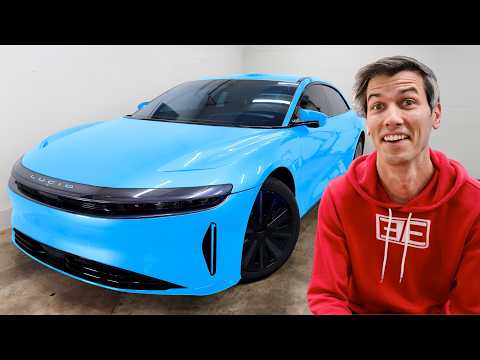
I Bought A Lucid Air - The Engineer's Dream Car!
The reviewer, an engineer, expresses immense admiration for the Lucid Air Touring, calling it one of the most impressive feats of automotive engineeri... moreng. The core theme is efficiency, which Lucid prioritizes to an extreme degree, enabling remarkable range and packaging. The reviewer highlights the car's exceptional spaciousness, powerful performance (0-60 in 3.2 seconds), quietness, and comfortable ride, all stemming from innovative engineering solutions like the battery pack design, continuous wave winding in motors, and integrated drive unit. While praising the car's substance, the reviewer is highly critical of the "Fathom Blue Metallic" paint, deeming it a boring shade of gray. The reviewer also advocates for the smaller 19-inch wheels for optimal range and performance. Despite Lucid's financial challenges, the reviewer finds the lease deal to be an extraordinary value, significantly cheaper than comparable Tesla, Porsche, or even Tesla Model 3 leases. The overall verdict is that the Lucid Air Touring is an exceptionally engineered, efficient, and spacious luxury vehicle that offers remarkable value, particularly when leased. less

Lamborghini Temerario – Brilliantly Engineered, Stupidly Fun
The Lamborghini Temerario is lauded as a brilliantly engineered and exceptionally fun supercar, successfully integrating a complex hybrid powertrain. ... moreThe reviewer highlights the 4.0L twin-turbo V8, capable of revving past 10,000 RPM, and its synergy with three axial flux electric motors, delivering a combined 907 horsepower. Key positives include the astonishing agility, immediate turn-in, and the sophisticated torque vectoring system, which makes the car feel nimble despite its weight and longer wheelbase. The reviewer praises the seamless integration of electric torque to mask turbo lag and the playful, tail-happy nature, enhanced by multiple drift modes. Minor criticisms include a slightly darty steering feel under heavy braking and noticeable noise in EV mode. The significant weight is acknowledged, though largely masked by the advanced powertrain and chassis tuning. Overall, the Temerario is celebrated for prioritizing driving enjoyment and character over mere performance figures, offering a unique and thrilling experience. less

Elon Musk Fired My Wife - I'm Selling My Tesla
The reviewer, Jason, is selling his Tesla Model 3 Performance after seven years and over 60,000 miles, citing a personal grievance against Elon Musk d... moreue to his wife's job loss at US Fish and Wildlife, which he attributes to Musk's influence on government efficiency initiatives. Despite this personal conflict, Jason acknowledges the Model 3 Performance as an exceptional daily driver with impressive performance and low running costs, estimating energy costs under $2,000 and maintenance under $600 (excluding a costly wheel/tire incident). He praises the driving dynamics, one-pedal driving, and the Supercharger network. However, he notes significant depreciation, with the car losing 75% of its value in seven years, contrary to Musk's claims of appreciating assets. Key criticisms include the abysmal automatic windshield wipers and the perceived "overpromise and underdeliver" strategy employed by Musk. Ultimately, while he is parting ways with his Tesla due to personal reasons, he still respects Tesla's mission and recommends buying their vehicles, particularly used ones, and provides a referral code. less

Cadillac’s Most Ambitious Car Ever – Engineering The Celestiq!
The Cadillac Celestiq represents an ambitious foray into the ultra-luxury segment, starting at a staggering $350,000. This video delves deep into the ... moreengineering marvels that justify its price tag, particularly focusing on the low-volume production techniques employed. The reviewer highlights the innovative use of massive aluminum castings for the chassis, a bespoke five-module battery pack enabling a low roofline, and over 100 3D-printed components, including safety elements. The carbon fiber hood, chosen for cost-effectiveness in low volumes and improved pedestrian safety, and the radar-transparent paint are also noted as unique engineering feats. In terms of driving dynamics, the Celestiq excels with its exceptionally compliant ride, attributed to air suspension, Magneride 4.0, and a first-for-Cadillac active roll control system that allows for a dual personality – plush touring or flat, sporty handling. However, the reviewer points out a couple of drawbacks: distracting reflections from the abundant metal trim on sunny days and a powertrain that, while powerful (655 hp, 303 miles EPA range), utilizes motors similar to other GM EVs, lacking the unique, bespoke feel expected at this price point. Space utilization is also questioned, with the massive exterior dimensions not translating into proportionally optimized interior or frunk space compared to competitors like the Lucid Air. Despite these criticisms, the overall impression is one of a highly customizable, comfortable, and visually stunning vehicle that pushes the boundaries of automotive engineering. less

This Car Just Drove Upside Down!
The McMurtry Spéirling achieves a groundbreaking feat by driving upside down solely through its generated downforce, without relying on momentum. The ... morevideo meticulously explains the engineering behind this capability, highlighting the car's fan system that creates a pressure differential to adhere to surfaces. While the car generates 2,000 kg of downforce, its potential is significantly higher, allowing for a margin of error in sealing. The review emphasizes the car's efficiency, consuming only 30 watts per kilogram of downforce, a stark contrast to passive aerodynamic solutions which require substantially more power. The Spéirling's performance is exceptional, with the ability to corner and brake at 3Gs even at low speeds, and achieve 0-60 mph in under two seconds. The presenter posits that while not suitable for street use, this technology could revolutionize racing, particularly in series like Formula E and Formula 1, by enabling closer racing, improving energy efficiency, and overcoming the limitations of turbulent air. less

Does The Tesla Cybertruck Have A Problem? Broken Tow Hitch!
This video investigates a critical failure point on the Tesla Cybertruck: its trailer hitch. After a test by JerryRigEverything revealed the hitch sna... morepping off at 10,400 lbs of force, below its 11,000 lb tow rating, the video delves into regulatory requirements and real-world stress scenarios. While the Cybertruck meets minimum SAE J2807 standards, the analysis suggests dynamic forces like heavy braking, potholes, and downhill towing could realistically exceed the hitch's breaking point. A significant concern is Tesla's use of an aluminum rear casting for the hitch attachment, contrasting with industry norms like Ram's use of steel. Steel offers superior stiffness, fatigue life (endurance limit), and toughness, crucial for towing applications. The video questions Tesla's material choice, especially given the 'tough, not fake tough' marketing, and highlights European regulations mandating steel for critical coupling components. Ultimately, while the Cybertruck meets basic requirements, the long-term durability and potential for failure under extreme, yet plausible, towing conditions raise valid concerns for customers. less

The World's First Hydrogen Combustion Outboard Engine!
This video provides an in-depth look at Yamaha's prototype hydrogen combustion outboard engine, a significant development in marine transportatio... moren's pursuit of reduced emissions. The reviewer highlights the core concept: burning hydrogen directly in a V8 engine, producing water as a primary emission. Key advantages discussed include the lightweight nature of hydrogen and the utilization of existing combustion engine technology. However, the primary drawback is the substantial challenge in achieving comparable range to gasoline counterparts due to hydrogen's low volumetric density. The prototype, based on a Regulator 26' hull, uses three 700-bar tanks, yielding an estimated range of only 46 miles compared to the gasoline version's 276 miles. The video thoroughly explores solutions for range extension, such as more tanks, higher pressure storage, and liquid hydrogen, while also detailing the engineering complexities of hydrogen storage, including tank expansion and the critical need for robust ventilation systems to manage potential leaks. Overall, it's presented as a promising, albeit early-stage, engineering proof of concept. less

VW ID Buzz Review - Exceptional Drive, Painful Interface
The 2025 Volkswagen ID. Buzz arrives in the US market as the sole electric minivan option, offering a compelling driving experience that belies its ut... moreilitarian roots. The "1st Edition" model, tested here in RWD configuration, boasts a 282 horsepower rear motor and a 91 kWh battery, delivering an estimated range of 234 miles. While the exterior and driving dynamics are praised for their exceptional feel and performance, the interior interface and infotainment system are highlighted as significant drawbacks, described as painful to use. Despite the high MSRP of $67,045, the ID. Buzz presents a unique proposition for those seeking an electric family vehicle, though potential buyers should be prepared for a steep learning curve with its controls. less

How To Ruin Your Electric Car's Battery - LFP Edition
This video delves into the nuances of Lithium Iron Phosphate (LFP) battery care in electric vehicles, contrasting manufacturer recommendations with re... morecent research. The presenter highlights that while Ford and Tesla suggest charging to 100% regularly for calibration and range accuracy, a new study indicates that operating within lower state-of-charge ranges (e.g., 0-60%) is more beneficial for long-term battery longevity. The core conflict arises because frequent high-state-of-charge cycling, especially above 75%, accelerates degradation by consuming lithium inventory. The video explains the voltage curve differences between LFP and NMC batteries, clarifying why LFP needs periodic full charges for accurate state-of-charge reporting. It concludes that for optimal longevity, minimizing time spent at high states of charge is key, suggesting that charging only when needed, rather than leaving the car plugged in constantly, might be preferable for LFP batteries, especially for those without home charging. However, the presenter cautions that these are best practices for longevity alone and don't negate the practical advice of keeping the car charged for emergencies or the risk of permanent damage from deep discharges. less

Red Bull Created A 15,000 RPM Hypercar - The V10 Is Back!
The Engineering Explained video delves into the highly anticipated Red Bull RB17 hypercar, a track-only machine designed by F1 legend Adrian Newey. Th... moree review highlights the car's extreme engineering, including a 15,000 RPM, 1,000 HP naturally aspirated V10 engine built by Cosworth, complemented by a 200 HP electric motor for a total of 1,200 HP. A key focus is the car's exceptional aerodynamics, featuring a massive diffuser and active fans, enabling it to generate 1,700 kg of downforce at 160 km/h, a figure limited by tire load capacity. The reviewer praises the innovative use of the hybrid system to eliminate the need for a starter, alternator, and reverse gear, while also aiding low-speed torque fill. However, a significant drawback identified is the car's track-only nature and the perplexing decision to limit downforce by road-legal tire specifications, despite it not being road-legal. The limited production run of 50 units and an $8 million price tag further underscore its exclusivity. less

Is Formula 1 About To Get Really Slow?
The 2026 Formula 1 rule changes are poised to significantly alter car performance, with a primary focus on reduced combustion power and increased reli... moreance on electric motors. While the new cars will have a higher total power output (750 kW vs. 680 kW), the analysis suggests they may actually be slower, particularly in corners, due to a 30% reduction in downforce. Top speeds are also capped, with electrical power dropping to zero above 345 km/h, limiting the top speed to an estimated 365 km/h, a decrease from current cars. Furthermore, the cars will carry less fuel and have a reduced energy recovery capacity per lap, leading to lower average power throughout the race. A key challenge highlighted is the battery's limited energy delta (4 megajoules), which restricts continuous acceleration on straights and efficient energy recovery during braking. This necessitates strategic adjustments, potentially involving longer braking zones to maximize regenerative braking, which could open up new strategic possibilities and overtaking opportunities. While initial projections point to slower lap times, the ingenuity of engineers may lead to unforeseen performance gains. less

Bugatti's Giant V16 Engine Is Insane - All The Tourbillon Details!
The Bugatti Tourbillon represents a significant departure from its W16 predecessor, embracing a naturally aspirated 8.3L V16 engine paired with three ... moreelectric motors for a combined output of 1,800 horsepower. The reviewer highlights the engine's glorious sound and response as key advantages of going naturally aspirated, a choice enabled by the electric motors compensating for power limitations. A notable feature is the car's dual personality: it can operate as a 1,800 HP AWD hybrid or a 1,000 HP RWD ICE-only vehicle. The reviewer is impressed by Bugatti's engineering to keep the weight under 2,000 kg despite the complex powertrain. However, a major point of contention is the Tourbillon's top speed potential. While capable of exceeding its 445 km/h limiter, the reviewer posits that battery limitations, specifically the duration of maximum power output from the electric motors, pose a significant challenge to reaching the coveted 500 km/h mark, a feat the reviewer doubts the car can achieve in its current configuration. less

Porsche's New 911 Engine Is Absolutely Brilliant - Formula 1 Tech!
Porsche's latest 911 GTS introduces a significantly revised hybrid powertrain, featuring a larger 3.6L single-turbo boxer-six engine complemented... more by an electric motor and an electric turbocharger. The review highlights substantial improvements in torque, a wider torque curve, and enhanced response, particularly at lower RPMs, thanks to the electric assistance. While the previous 3.0L engine offered 473 hp, the new system, including the electric motor, achieves 532 hp and 449 lb-ft of torque, with a notable reduction in turbo lag. A key focus is Porsche's achievement of maintaining Lambda=1 (stoichiometric air-fuel ratio) across most operating conditions, which optimizes emissions and catalytic converter efficiency. This is made possible by the larger displacement, electric turbo, and precise management, allowing for greater power without the need for rich mixtures that typically compromise emissions. The only significant drawback identified is a slight weight penalty, though it's deemed surprisingly minimal given the added components. Performance gains are evident, with the new GTS completing the Nürburgring Nordschleife nearly 9 seconds faster than its predecessor. less

Here's The Proof... Tesla Cybertruck vs Porsche 911 Drag Race
This video meticulously debunks Elon Musk's claim that the Tesla Cybertruck, while towing a Porsche 911, could out-drag the 911 on its own. The &... morequot;Engineering Explained" host, Jason Fenske, partners with MotorTrend to conduct a real-world test. Despite Tesla's marketing suggesting a win, the results clearly show the Porsche 911 T (manual transmission) is faster, both in the eighth and quarter miles, even when the Cybertruck is given a slight weight advantage. Fenske highlights that while the Cybertruck has impressive initial acceleration, its overall performance is hampered by the added weight and drag of towing. The video also delves into the physics and math behind acceleration, explaining why Tesla's claim was improbable. While the Cybertruck's towing acceleration is acknowledged as "bonkers" and its stability impressive, the core verdict is that it cannot beat a 911 while towing, contrary to Tesla's unsubstantiated marketing. less

Hyundai Changed The Game - An "8-Speed" Electric Car!
The Hyundai Ioniq 5 N represents a bold new direction for performance EVs, aiming to bridge the gap for combustion engine enthusiasts. The reviewer hi... moreghlights the extensive customization options, particularly the "N e-Shift" feature, which simulates an 8-speed dual-clutch transmission with realistic torque loss and simulated engine braking, enhancing driver engagement. The "N Active Sound+" system offers various sound profiles, including a convincing ICE N engine sound. While the reviewer praises the deep customization and the effort to make EVs more engaging, they acknowledge the vehicle's significant weight (over 4600 lbs), which is noticeable on the track. Features like "N Pedal" and adjustable "N Torque Distribution" are noted for their ability to manage this weight and enhance handling. The "N Drift Optimizer" with "Torque Kick Drift" is presented as a sophisticated tool for drifting. Overall, the reviewer found the Ioniq 5 N fun to drive, appreciating the driver-centric approach that allows extensive personalization, though more time is needed for a complete assessment. less

The Most Powerful Porsche Ever - Taycan Turbo GT - A Lineup Leveled Up
The latest generation Porsche Taycan, particularly the Turbo GT, represents a significant leap forward in EV technology. The reviewer highlights subst... moreantial improvements across the board: increased battery capacity (105 kWh gross, 99.7 kWh usable) and efficiency, leading to a claimed 34% range increase. Weight has been reduced despite the larger battery, and power output is dramatically enhanced, with the Turbo GT boasting up to 815 kW (approx. 1100 hp) and achieving 0-100 km/h in 2.2 seconds. Charging speeds are also improved, with a 10-80% charge in 18 minutes, and crucially, the battery can now fast charge effectively at lower temperatures (down to 15°C from 35°C). The powertrain benefits from new silicon carbide inverters, enabling higher current delivery. The standout feature is the new Porsche Active Ride suspension, which uses electric motors and pumps at each damper to actively control ride height and eliminate pitch, dive, and roll, enhancing both performance and comfort. While the reviewer notes a compromise in brake pedal feel due to blended regen and friction braking, the overall consensus is that the new Taycan, especially the Turbo GT, is a vastly superior offering, making current owners due for an upgrade. less

Bugatti Has Developed A V16 Engine!
Bugatti has unveiled its next-generation hypercar powertrain, centered around a new V16 hybrid engine, marking a significant departure from its previo... moreus W16. The video meticulously breaks down the engineering of this new V16, drawing parallels and contrasts with the iconic W16 found in the Veyron and Chiron. Key insights include the V16's 90-degree V-angle, its crossplane crankshaft design, and the sophisticated firing order derived from analyzing prototype images. While official specifications are scarce, the analysis delves into reported figures of an 8.3L naturally aspirated Cosworth V16 producing 1,000 horsepower, complemented by electric motors for a combined output potentially around 1,800 horsepower. The reviewer validates the feasibility of these reported numbers through detailed calculations, suggesting a naturally aspirated configuration is likely due to intake manifold design and power output characteristics. The integration of electrification is highlighted as a strategic move to enhance the already impressive torque curve, providing instant torque from zero RPM and smoothing out power delivery across the entire rev range. Despite the complexity and cost, the V16 hybrid strategy is deemed fitting for the Bugatti brand and its discerning clientele, promising a unique and unparalleled performance experience. less
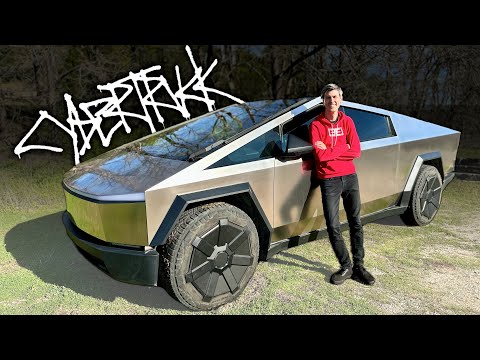
Driving Tesla Cybertruck - Overhyped or the Pickup Reinvented?
The Tesla Cybertruck is presented as a revolutionary reinvention of the pickup truck, featuring a polarizing, futuristic design. While its unique shap... moree offers significant torsional stiffness and more enclosed cargo space, it presents some aerodynamic compromises and limits side bed access. The vehicle's engineering highlights include an 800V powertrain and a 48V accessory system, which are noted as smart engineering decisions for efficiency and component power, though largely irrelevant to the average consumer's driving experience or range. The steer-by-wire system, a first for a production vehicle without mechanical backup, is praised for its adjustability and unique feel, though it requires an adjustment period. Rear-wheel steering significantly enhances maneuverability. For truck functionality, the Cybertruck excels with ample storage, powerful 110/240V outlets, bidirectional home charging, and a durable stainless steel exterior. However, it falls short on advertised towing capacity and notably lacks a spare tire, a significant drawback for a truck. Driving impressions suggest a familiar Tesla experience with strong acceleration and regen braking, but it distinctly feels like a heavy truck rather than a car, despite its rigidity. The interior is well-received, though the steering wheel-mounted turn signals are a point of contention. The reviewer concludes that while the Cybertruck is a solid, practical, and impressive engineering feat with potential for future software improvements, it doesn't quite live up to the extreme hype, feeling more familiar than otherworldly upon driving. less

Lucid Sapphire Smashes Tesla Plaid's Acceleration
The Lucid Air Sapphire is presented as a groundbreaking hyper-sedan, fundamentally outperforming the Tesla Model S Plaid in acceleration, even under l... moreess-than-ideal public road conditions. The review highlights the Sapphire's advanced tri-motor setup (1,234 HP) as the key differentiator, enabling superior traction and power distribution compared to the Plaid's dual-motor system. While acknowledging the Plaid's efficiency and speed, the Sapphire is lauded for its superior handling, described as potentially the best in any passenger car, offering exceptional neutrality and driver engagement without compromising ride comfort or luxury. The primary drawback identified is the infotainment system's complexity and occasional synchronization issues, though this is framed as a minor flaw in an otherwise meticulously engineered vehicle. The steep $250,000 price tag is justified by its engineering prowess, positioning it as a halo product that showcases Lucid's commitment to performance and innovation, albeit with concerns about long-term business viability. less
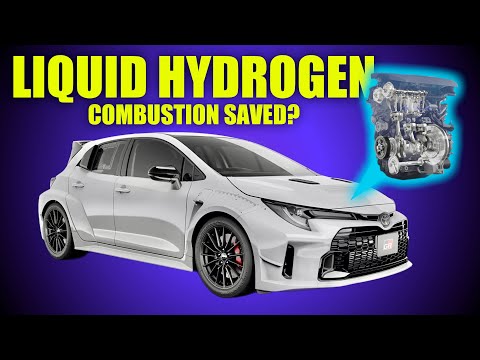
Toyota Developed A Liquid Hydrogen Combustion Engine
This video delves into Toyota's innovative development of a liquid hydrogen combustion engine, showcased in the Fuji 24-hour race. While acknowle... moredging Toyota's engineering prowess and the potential for carbon-free racing, the review highlights significant challenges. The primary issues identified are the extreme difficulty in maintaining the fuel pump's integrity at cryogenic temperatures and the inherent volumetric inefficiency of hydrogen storage, even in liquid form, compared to gasoline. The reviewer points out that despite advancements in storage density, the energy density by volume remains a major hurdle, necessitating impractically large tanks for reasonable range. Furthermore, the fuel pump's unreliability, requiring multiple replacements during the race, and the resulting power reduction due to lower injection pressure, significantly impacted performance. The video concludes that while Toyota's effort is commendable, the practical limitations, particularly the boil-off issue and the need for specialized, large tanks, make liquid hydrogen combustion unviable for widespread passenger car adoption. Synthetic fuel is presented as a more practical, albeit costly, alternative. less