
Auto Expert John Cadogan positions itself as a vital resource for navigating the complexities of the automotive world, particularly within the highly competitive Australian market. The channel delves into the everyday realities of car ownership, addressing common frustrations and offering insights into the decision-making processes behind purchasing and maintaining vehicles. It aims to demystify the automotive landscape for consumers, providing expert guidance on a range of topics.
With a focus on practical advice and in-depth analysis, Auto Expert John Cadogan covers essential aspects of vehicle ownership, from the nuances of upgrading older cars to the critical factors influencing tyre performance and safety. The channel also engages with contemporary issues such as electric vehicle (EV) technology, exploring both the potential and the challenges associated with their widespread adoption and integration into existing infrastructure.
With a focus on practical advice and in-depth analysis, Auto Expert John Cadogan covers essential aspects of vehicle ownership, from the nuances of upgrading older cars to the critical factors influencing tyre performance and safety. The channel also engages with contemporary issues such as electric vehicle (EV) technology, exploring both the potential and the challenges associated with their widespread adoption and integration into existing infrastructure.

When Should I Upgrade My Old Car? | Auto Expert John Cadogan
John Cadogan tackles the perennial question of when to upgrade a vehicle, offering a pragmatic perspective that challenges the industry's push for constant turnover. He argues that keeping a car longer significantly reduces depreciation and environmental impact, directly refuting the "greenwashin...


Latest Additions
Showing 24 of 285 total titles. Page 6 of 12.

Kia EV9 Electric 7-Seat SUV: Morbidly Obese, and Far From Green
John Cadogan delivers a scathing critique of the Kia EV9, labeling it a "morbidly obese" and "rolling contradiction." While acknow... moreledging its potential comfort, luxury, and capability, he argues its sheer size and weight (2.6 tons, heavier than a Land Cruiser 300) negate any environmental benefits, deeming it a "waste of mundane resources." Cadogan is particularly critical of the lack of transparency regarding battery chemistry, suspecting cobalt use and highlighting the significant fire risk and lack of recycling mandates. He questions the "opportunity cost" of such a large battery, suggesting the resources could be better used for stationary home storage. Ultimately, he concludes the EV9 is a "breathtakingly multifaceted irrelevance," failing to justify its existence or cost in the context of genuine climate action, and suggests a diesel Sorento with a home solar setup would be a greener alternative. less

Tesla EVs Are Just Too Expensive to Own - Says Hertz CEO
The CEO of Hertz is reportedly slamming the brakes on the company's ambitious EV fleet expansion, primarily due to the high operating costs and p... moreoor resale value of Tesla vehicles. The transcript highlights that Hertz's initial plan to acquire nearly 200,000 EVs, including 100,000 Teslas, has proven to be a costly misstep. The reviewer criticizes the "green virtue signaling" aspect of the deal, suggesting it lacked a solid business case. Key issues cited include the significant expense of maintaining the EVs and their rapid depreciation, which has led to substantial financial losses for Hertz. The review also touches upon Tesla's own challenges, such as price slashing and increasing competition, suggesting a potential collapse of the brand if price cuts are its only strategy. Ultimately, the video argues that Hertz's focus on appearing "woke" has detracted from its core business of providing reliable rental services, leading to a costly and unsustainable EV strategy. less

Reacting to Your Nissan E-Power Feedback and Criticism
John Cadogan delivers a scathing critique of Nissan's e-Power hybrid system, dismissing it as an "appalling piece of crap" and "ma... morerketing horseshit." He argues that the system's complexity, with its generator, inverter, and traction motor, results in a net efficiency loss compared to conventional mechanical drivetrains, citing Second Law of Thermodynamics limitations. Cadogan highlights the significant weight penalty (239 kilos for the AWD e-Power X-Trail) and the small battery capacity (2.1 kWh), suggesting it offers minimal EV-only driving capability. He contrasts Nissan's 22% fuel efficiency improvement over its combustion counterpart with more substantial gains seen in competitors like the Toyota Kluger (36%) and GWM Haval H6 (37%), questioning the e-Power's purported advanced technology and optimal engine operation claims. While acknowledging the appeal of hybrid technology for urban emissions, Cadogan concludes that Nissan's e-Power is a "hastily concocted joke" that falls short of its marketing promises and is inferior to conventional hybrid systems. less

Let's Roast: Land Rover Defender Plug-in Hybrid EV! | Auto Expert John Cadogan
John Cadogan delivers a scathing review of the Land Rover Defender 110 plug-in hybrid, labeling it an "irrelevant plug-in hybrid dung box" a... morend a "wanking Chariot." He heavily criticizes its late arrival to the Australian market, its premium price point ($220,000 more than the ICE version), and the questionable efficiency claims (5.6 seconds to 100 km/h while claiming 3.4 L/100km). Cadogan highlights the potential for "recidivist in trouser defecation issues" and the irony of a heavy, Slovakian-built 4x4 being marketed as environmentally virtuous. He questions the "zero emissions" claim, citing Australian Consumer and Competition Commission (ACCC) guidelines against greenwashing. The review concludes that owning a Defender is ultimately about losing oneself – sanity, finances, and potentially anonymity, especially after incidents like battery fires. less

Science Versus Your Lithium-ion and EV Firefighting Feedback
This video delves into the critical issue of EV battery fires, specifically examining a novel firefighting technique deployed by Danish Vikings using ... morea super-cooled, high-concentration brine solution. The reviewer, John Cadogan, praises the ingenuity of the system, highlighting its effectiveness in absorbing heat and discharging batteries to prevent re-ignition. He discusses the potential for this method to be adapted for broader applications, including onboard ferries and as a secondary hazard control measure on land. Cadogan also addresses concerns about chlorine gas production, citing scientific studies that suggest the quantities are negligible compared to other toxic off-gassing from thermal runaway events. While acknowledging the logistical challenges of transporting large volumes of brine, he strongly advocates for the development and deployment of such systems, emphasizing the increasing frequency of EV battery fires and the inadequacy of current countermeasures. The review concludes that while not perfect, the brine solution represents a significant step forward in managing a serious societal risk. less

Another Lithium-Ion Battery Fire Proves We're Not Ready for EVs
This video critiques a recent lithium-ion battery fire involving multiple e-bikes, highlighting perceived failures in both media reporting and emergen... morecy response. The reviewer criticizes the Seven News coverage for sensationalism and a lack of substantive information, particularly questioning the reporter's proximity to the hazardous scene. A significant point of contention is the Metropolitan Fire Service's handling of the initial fire, specifically their decision to pile the charred e-bikes in the sun, which the reviewer argues directly led to a foreseeable and preventable secondary fire (thermal runaway). The reviewer posits this indicates a systemic failure in policy and training for dealing with lithium-ion battery fires. While acknowledging the firefighters' bravery, the core message is that authorities are ill-prepared for the increasing prevalence of these fires, especially with larger EV batteries, and that a lack of investment in specialized equipment and training is a critical issue. The reviewer concludes that this incident is emblematic of a broader societal unpreparedness for the risks associated with EV technology, driven by political narratives prioritizing an "electric utopia" over practical safety concerns. less

Best EV Firefighting (Thermal Runaway) Technique Yet!
John Cadogan reviews a groundbreaking EV firefighting technique developed by the Faroese company, Scandi Offshore. The method utilizes a super-cooled ... morebrine solution, significantly colder than water, to combat thermal runaway in EV batteries. The system, demonstrated on a Renault, successfully extinguished a simulated battery fire within an hour by injecting the brine through a broken window. Cadogan highlights the brine's dual action: cooling the battery below the critical temperature and discharging it, preventing reignition. He praises the ingenuity of the solution, noting its practicality for maritime transport, especially on ferries where submerging vehicles is impossible. However, he identifies a critical missing piece: a standardized, universal quick-connect port on all EVs for direct brine injection into the battery pack. Cadogan argues this standardization is crucial for first responders, enabling faster and more effective intervention in real-world emergencies, potentially saving lives. He critiques the lack of such a feature as a significant oversight by manufacturers and regulators, emphasizing the need for global collaboration to implement this safety standard. less
A Giant Tesla Battery Caught Fire And They Just Let It Burn
This video critically examines a Tesla Megapack battery fire in Queensland, Australia, highlighting significant safety concerns. The reviewer, John Ca... moredogan, expresses dismay that authorities are 'just letting it burn' due to the lack of effective firefighting capabilities for such incidents. He criticizes the inadequate on-site safety measures, including the absence of dedicated fire suppression systems and proper module separation, drawing parallels to the Chernobyl disaster in terms of systemic safety failures. Cadogan questions the perceived safety of lithium iron phosphate batteries, citing their potential to off-gas toxic substances like carbon monoxide, hydrofluoric acid, and hydrochloric acid. He argues that the project, despite being energized, was not fully commissioned, raising further questions about its readiness. The review points to a broader lack of safety culture in the deployment of large-scale battery storage, suggesting that cost-saving measures and political pressure to appear 'green' are compromising essential safety protocols. The advice given to nearby residents to 'shut your doors and grab your drugs' is deemed insufficient, underscoring the need for better upstream safety engineering. less
EV Battery Vapour Explosions: Nobody Will Admit It's a Problem
John Cadogan of AutoExpert.com.au critically examines a concerning incident where a Jeep Wrangler 4xe's battery underwent thermal runaway, produc... moreing an explosive vapor cloud that dislodged a garage door and narrowly missed a firefighter. While acknowledging the general safety of EV technology and its comparable fire rates to combustion vehicles, Cadogan emphasizes the different, high-consequence nature of EV battery fires. He highlights the risk of vapor cloud explosions in enclosed spaces, drawing parallels to gasoline leaks but noting the added toxicity of EV battery off-gassing. The review stresses the need for open discussion on mitigation strategies, such as charging EVs outdoors and improving ventilation in garages, rather than relying solely on assurances of safety. Cadogan advocates for a proactive approach, including potential changes to building codes and owner's manuals, to address the low-probability but severe risks associated with EV battery incidents. less

Is Your New Car Actually Spying On You? The Unpalatable Truth.
John Cadogan delivers a scathing critique of the automotive industry's privacy practices, labeling car companies as the worst offenders in data c... moreollection. He highlights a Mozilla Foundation report revealing that most car brands, including Tesla, Volkswagen, Toyota, Ford, Nissan, and others, collect excessive personal data, often inadequately secured and sold to third parties. Cadogan expresses outrage over the potential misuse of this data, citing examples like its use in law enforcement investigations or for inferring personal characteristics. He criticizes Tesla's opt-out policy, which can lead to reduced vehicle functionality, and Nissan's policy requiring owners to inform occupants about data collection. The review concludes with a call for stricter legislation and proposes a satirical but pointed 'Aggravated Corporate Weaselry' offense with severe penalties, emphasizing the urgent need for consumer data protection. less

Sydney Airport EV Fire: One Battery Incinerated Five Parked Cars
This report details a concerning incident at Sydney Airport where a damaged, detached EV battery, left exposed to the elements by a rental company, ig... morenited and destroyed five vehicles, including the one it was removed from. The reviewer criticizes the mainstream media's sensationalist coverage, particularly the use of the term 'explosion,' and highlights that the fire was likely contained by airport firefighters before it could reach catastrophic thermal runaway. The core issue identified is not the EV technology itself, but the gross negligence of the rental company (inferred to be Europcar) in improperly handling a damaged high-voltage battery. The report emphasizes that while EV fires are rare, the potential severity in enclosed spaces is a significant concern not adequately addressed by current safety plans. The reviewer stresses the importance of proper training and procedures for handling damaged EV batteries, contrasting the rental company's actions with industry standards and suggesting regulatory oversight is needed. less

The Golden Age of Bullshit
This video critically examines the "golden age" of perceived progress, particularly focusing on electric vehicles and Australia's role ... morein global emissions. The presenter, John Cadogan, argues that claims of environmental salvation through EVs are often misleading, highlighting Tesla's reliance on diesel generators at Supercharger stations as a prime example. He criticizes the lack of transparency regarding the true carbon footprint of EV charging and the broader energy infrastructure. Cadogan also points out Australia's hypocrisy in promoting Net Zero while being a leading exporter of coal and natural gas, the burning of which significantly contributes to global emissions. The review suggests that while the desire for progress is understandable, the current approach, often championed by figures like Elon Musk, is a form of self-delusion that fails to address the scale of the problem. The presenter's verdict is that these initiatives are "worse than nothing" as they create a false sense of accomplishment without tackling the fundamental issues of energy consumption and production. less

Fremantle Hwy: Mercedes EV Battery Burns One Month Later
This video critically examines the aftermath of the Fremantle Highway incident, focusing on a Mercedes-Benz EQE that caught fire a month after the ini... moretial event. The reviewer highlights the perceived cover-up and lack of transparency surrounding the incident, questioning assurances of the EVs' safety. The EQE, initially deemed 'perfectly movable,' spontaneously reignited due to a battery fire, necessitating its disposal in a Hazmat bin. The expert argues that the presence of EVs inherently elevates risks in enclosed spaces like ships and car parks, increasing fire severity, toxicity, and difficulty in suppression. He criticizes the 'electric utopia' narrative, suggesting a conflict between appeasing EV proponents and prioritizing public safety based on facts. The review also touches upon other battery fire incidents and the inherent risks of thermal runaway and confined vapor cloud explosions associated with EV batteries, urging for better safety measures and disclosure. less

Time to Roast Some A-Grade Pro-EV Nuts
John Cadogan delivers a characteristically blunt and fact-driven critique of common EV arguments, directly addressing 'EV nuts' in the comme... morents. He debunks claims about lower running costs by highlighting the significant upfront price difference and questions the longevity of EV components, particularly the battery, suggesting they won't last the touted one million miles. Cadogan also points out the existence of cooling systems and 12-volt batteries in EVs, contrary to some popular assertions. While acknowledging EVs' potential long-term benefits, especially when charged by solar, he raises practical concerns about charging accessibility for apartment dwellers. The review also touches on the environmental impact of electricity generation in Australia (coal-heavy) and the sustainability claims surrounding the Polestar 3, particularly its use of leather and recycled materials, which he argues are smoke screens for a highly consumptive vehicle. Cadogan's core message is that while EVs have merits, the current narrative often overlooks practical challenges and exaggerates benefits, urging a more grounded, fact-based discussion. less

Evs Are a Climate Action Fraud: Here's Why
John Cadogan argues that Electric Vehicles (EVs) are a climate action fraud, not because they are inherently bad to drive or bad for local pollution, ... morebut due to their misrepresentation as a primary climate solution. He contends that the significant CO2 emissions associated with electricity generation, particularly from coal in Australia, dwarf the benefits of EVs. Cadogan highlights that the massive batteries in luxury EVs like the Polestar 3 and Kia EV9 are environmentally problematic due to resource intensity and toxic potential, and their size is excessive for the actual CO2 savings achieved. He proposes that repurposing these large batteries for grid storage or to take homes off the grid would be a far more effective climate strategy, saving significantly more CO2 than individual EV ownership. The reviewer criticizes governments and industry for focusing on EVs as a solution while ignoring larger emission sources like coal power and trucking, labeling the current EV push as a "fraud" and a "conga line of mother lovers" selling ineffective virtue signaling. less

The Great Greenwashing 'Zero Emissions' Lie! (ACCC Weighs In.)
The reviewer critically examines the concept of 'zero emissions' vehicles, arguing that most environmental claims, particularly from governm... moreents and car manufacturers, are fundamentally misleading. The video highlights an Australian Competition and Consumer Commission (ACCC) document advising businesses to qualify claims about zero emissions, as they often fail to account for manufacturing and charging emissions. The reviewer uses the Victorian government's 'zero emissions vehicle road map' as a prime example of what they deem 'weapons-grade environmental bullshitters,' contrasting its claims with the significant emissions associated with electricity generation and household energy consumption. The core argument is that focusing on EVs distracts from larger issues like the electricity grid's carbon footprint, and that the term 'zero emissions' for vehicles is an outright lie given the materials and energy required for their production and operation. The reviewer concludes that trust in institutions is eroding due to such deceptive practices. less

Is a Plug-in Hybrid (PHEV) Really Ready for the Australian Outback?
John Cadogan delivers a scathing critique of Mitsubishi's marketing campaign for the Outlander Plug-in Hybrid (PHEV), particularly its claims of ... morebeing 'rugged ready' for the Australian Outback. He argues that the vehicle is fundamentally unsuited for such environments due to its lack of a spare tire, reliance on a tire repair kit, and 20-inch alloy wheels with soft highway tires. Cadogan highlights that while the PHEV boasts a large battery for EV commuting and decent regional travel capabilities, its true strengths lie in its efficient EV range and hybrid system for urban and highway use, not off-road adventures. He contrasts this with vehicles like the Triton and Pajero Sport, which are genuinely rugged. The reviewer concludes that Mitsubishi's misrepresentation is a disservice to both potential buyers and the vehicle itself, which is otherwise a competent plug-in hybrid for its intended purpose. less

First Burnt-Out EV on Fremantle Highway Revealed: Leaked Photo! | Auto Expert John Cadogan
This video presents photographic evidence of a burnt-out Porsche Taycan on the Fremantle Highway car carrier, directly contradicting claims that all e... morelectric vehicles (EVs) on board survived the fire. The host, John Cadogan, uses this image as a 'smoking gun' to argue against what he terms 'EV evangelism' and the denial of inherent risks associated with transporting EVs and hybrids. While acknowledging the potential benefits of EVs as an alternative to internal combustion engines, Cadogan criticizes the 'cult-like' behavior of some EV proponents who refuse to acknowledge risks. He highlights that while the cause of the fire remains officially undetermined and not linked to EVs by the salvage company, the presence of large lithium-ion batteries inherently elevates risk during transport. The video emphasizes that the focus should be on improving safety standards rather than denying potential dangers, citing an increase in ship fires involving lithium-ion batteries. less

The Truth About EV Battery Recycling
John Cadogan delivers a scathing critique of the EV industry's approach to battery recycling, labeling much of the marketing as "greenwashin... moreg." He argues that the popular fantasy of batteries being resurrected or easily recycled is a myth, with the reality being that most end up in landfills. Cadogan highlights the lack of adequate recycling infrastructure in Australia, citing projections of massive amounts of lithium-ion battery waste by 2030 and 2036. He criticizes car manufacturers for misleading consumers about recyclability and points to Nissan's "node" project as a prime example of "greenwashing" with minimal environmental impact. The reviewer emphasizes that while selling EVs is easy, integrating them responsibly into society, particularly concerning end-of-life disposal and safety, is a significant challenge that is currently being neglected. less
Reacting to Your EV Versus ICE Criticisms and Feedback
John Cadogan's latest video tackles common criticisms and feedback regarding Electric Vehicles (EVs) versus Internal Combustion Engine (ICE) vehi... morecles. He critically examines the optimistic projections for EV adoption, highlighting concerns about battery waste, the age of EV technology, and the car industry's profit motives driving planned obsolescence rather than sustainable upgrades. Cadogan questions the feasibility of a complete EV transition, citing the immense demand for lithium, the slow pace of mining approvals, and the current lack of viable alternatives for heavy transport and logistics. He argues that hydrocarbons have been fundamental to human progress and that a complete abandonment of ICE vehicles would lead to societal collapse. While acknowledging some points made by EV proponents, Cadogan emphasizes the need for factual analysis over emotional arguments and expresses skepticism about the rapid, large-scale EV transition many governments are mandating. less

Reacting to Your EV Battery Fire Criticisms and Feedback
John Cadogan addresses common criticisms and misconceptions surrounding EV battery fires, particularly in light of the Fremantle Highway incident. He ... moredebunks the myth that lithium-ion phosphate batteries cannot burn, citing scientific research that highlights their thermal runaway potential above 80°C. Cadogan also clarifies the risks and realities of fighting EV fires, emphasizing that water is generally used safely by fire departments, though access and PPE are crucial. He critiques the logic of comparing EV fires to oil spills, arguing both are undesirable. A significant portion of the video delves into Australia's greenhouse gas emissions, challenging the narrative that light vehicles are the primary culprit and suggesting a greater focus on stationary energy and fugitive emissions from coal mines. The review concludes with a strong endorsement of George Carlin's comedic genius and a recommendation to watch his 'Advertising Lullaby' satire. less

The Truth About EVs and Fire Risk in Our Cities
John Cadogan delivers a stark warning about the potential fire risks associated with Electric Vehicles (EVs), particularly in urban environments and d... moreuring shipping. While acknowledging EVs' benefits for urban pollution and energy security, he argues that the low probability but high consequence nature of EV fires, especially thermal runaway events, presents a significant, unaddressed societal hazard. Cadogan criticizes the lack of robust, systematic safeguards for EV fires, contrasting it with the established safety protocols for gasoline. He highlights incidents like the Fremantle Highway fire as evidence of the catastrophic potential when EVs are involved, especially in contained spaces like ships or underground car parks. The reviewer emphasizes that the focus should be on implementing comprehensive safety regulations and infrastructure, rather than solely on the environmental benefits of EVs, which he argues are overstated in the context of overall greenhouse gas emissions. His verdict is that while EVs are a reality and have their place, their integration into society is currently being handled disgracefully without adequate safety considerations, risking future disasters. less
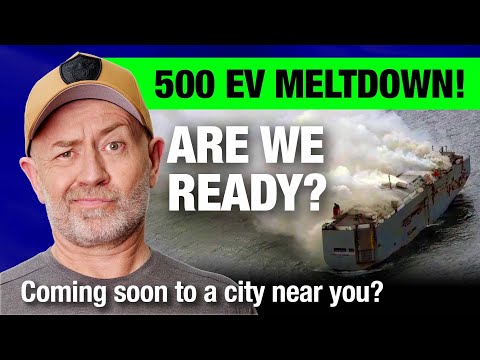
Runaway 500 EV Meltdown on Cargo Ship: Proof Our Cities Aren't Ready for Full EV Deployment
This video critically examines the Fremantle Highway EV fire, arguing that the severity and duration of the blaze are directly attributable to the pre... moresence of 500 electric vehicles. The reviewer dismisses claims that an EV battery initiated the fire, focusing instead on the inherent dangers of lithium-ion battery thermal runaway, which produces its own oxygen and burns hotter and longer than gasoline fires. The analysis highlights the difficulty in fighting such fires, contrasting the limited actions taken by the Dutch Coast Guard (cooling the hull, securing the vessel) with the impossibility of actively suppressing the battery inferno. The video posits that this incident serves as a stark warning for the future, particularly concerning the safety of EVs in confined spaces like underground car parks, where a single malfunctioning battery could trigger a catastrophic event with severe toxic emissions, including hydrofluoric acid and heavy metals. The reviewer criticizes the lack of preparedness and regulatory foresight from authorities and car manufacturers, suggesting a systemic failure to address the unique risks associated with widespread EV adoption. less

MG4 Excite 51 EV: Q&A - Responding to Your Questions & Comments | Auto Expert John Cadogan
This Q&A video addresses viewer questions following a livestream of the MG4 Excite 51. The reviewer clarifies that while Lithium Iron Phosphate (L... moreFP) batteries lack cobalt and are less prone to thermal runaway than other chemistries, they can still experience catastrophic thermal runaway at higher temperatures. Regarding resale value, the expert suggests a 10-15 year old EV will be worth about as much as a comparable conventional car, emphasizing that battery condition is key and second-life use for home energy storage is a viable option. He also explains that modern EVs, like the MG4, use advanced electronic systems for brake force distribution and regenerative braking, making the axle performing regen less critical than in older combustion cars. The reviewer dismisses concerns about spare tires being a cost-cutting measure by manufacturers and criticizes the trend of non-dismantable structural batteries in newer EVs, deeming them a future hazardous waste problem. He reiterates his view that EVs are not the primary solution to climate change but a 'weaponized sideshow' distracting from the continued approval of fossil fuel projects. less