
Branden Flasch, formerly known as "EV Nomads," is a seasoned voice in the electric vehicle community. With extensive personal experience driving a range of EVs, including the Tesla Model Y, Ford F150 Lightning, Tesla Model S, VW ID.4, and more, Flasch brings a deep understanding of the electric driving landscape.
This distributor specializes in sharing insights on new EV models, the nuances of EV charging, and practical advice for electric vehicle travel. Leveraging years of hands-on experience and professional involvement in the EV charging industry, Branden Flasch offers a knowledgeable and engaging perspective for EV enthusiasts and those considering the transition to electric mobility.
This distributor specializes in sharing insights on new EV models, the nuances of EV charging, and practical advice for electric vehicle travel. Leveraging years of hands-on experience and professional involvement in the EV charging industry, Branden Flasch offers a knowledgeable and engaging perspective for EV enthusiasts and those considering the transition to electric mobility.

Farewell ID.4 - The Truth About The VW ID.4 After 1 Year and 16k Miles
After one year and 16,000 miles, the reviewer concludes that the 2021 Volkswagen ID.4 Pro S RWD, while possessing good hardware and offering a comfortable ride suitable for long distances, is significantly let down by its software. Key criticisms include the lack of one-pedal driving, the absence...


Latest Additions
Showing 24 of 188 total titles. Page 5 of 8.

Day Trip in Rivian R1T to Look At Used Model 3
The reviewer embarks on a day trip in their Rivian R1T to inspect a 2018 Tesla Model 3 Long Range Rear Wheel Drive. The primary focus is the Tesla... more9;s significantly reduced price, dropping from $44k to $29k, and its inclusion of Full Self-Driving (FSD). Despite the attractive price and the reviewer's personal preference for the silver metallic color, the Model 3's condition proved disappointing. Issues included mismatched paint, a cracked roof glass, and inconsistent paint protection film application. The reviewer also noted the long-range RWD Model 3 felt slow compared to their Rivian. Ultimately, the dealership's one-price policy and the car's condition led the reviewer to decline the purchase, suggesting a price of $25k or less would be more appropriate, especially considering the used EV tax credit eligibility. The trip also highlighted the reviewer's charging experiences with EVgo and Electrify America, noting the latter's capacity issues during peak times. less
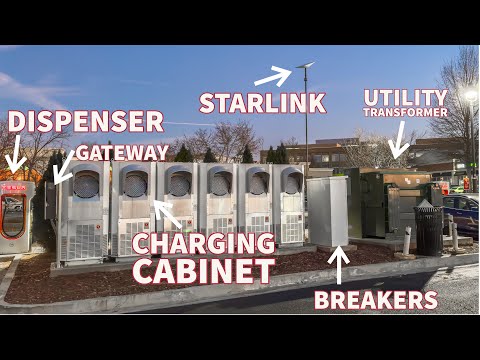
Tesla vs Rivian vs Electrify America vs EVgo vs Freewire Charging Infrastructure Site Architecture
This video provides an in-depth look at the site architecture of various DC fast charging networks, including Rivian Adventure Network, Tesla Supercha... morerger (v2 and v3), FreeWire, Electrify America, and EVgo. The reviewer, Branden Flasch, meticulously breaks down the components from utility transformers and switchgear to distribution cabinets and charging dispensers. He highlights key differences, such as Rivian and Tesla's dispenser-based systems versus FreeWire's all-in-one battery-integrated units. A major point of comparison is the power distribution and potential for future upgrades. Tesla's v3 Supercharger network is lauded for its efficient site architecture with DC buses enabling power sharing between cabinets, maximizing grid connection utilization. However, the reviewer notes a potential limitation in scaling to higher charging demands. FreeWire's solution is praised for its minimal infrastructure requirements, often negating the need for utility upgrades, making it ideal for locations with limited grid capacity. Electrify America and EVgo sites are also detailed, with the reviewer pointing out specific configurations like the cabinet-to-dispenser ratios and power output limitations. Overall, the video offers a comprehensive technical comparison, emphasizing the engineering behind EV charging infrastructure. less

Time to Head Back to North Carolina
This video documents a road trip from South Florida to Charlotte, NC in a Rivian R1T. The reviewer, Branden Flasch, provides a detailed, albeit somewh... moreat disorganized, account of his journey, focusing heavily on charging experiences and efficiency. Key takeaways include the Rivian R1T's generally good efficiency, especially when driven conservatively (achieving 2.17 miles/kWh on the final leg), and the inconsistent reliability of public charging infrastructure, particularly Electrify America stations which were frequently down or underperforming. The reviewer highlights issues with charging speeds, station availability, and the need for meticulous planning. While the trip was extended due to fatigue and a desire for more leisurely charging stops, the reviewer ultimately made it home, reflecting on the overall experience and the vehicle's performance, while also noting some software quirks in energy reporting. less
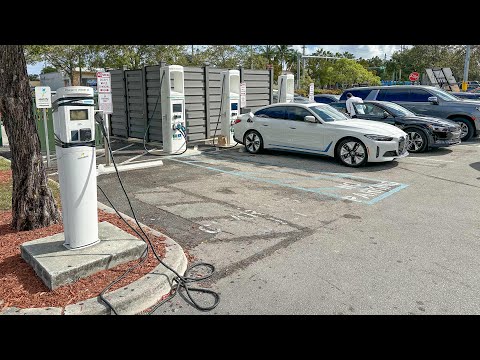
More Broken Than Working Chargers
The reviewer conducted a charger audit across Southeast Florida, visiting numerous charging stations from various providers including Electrify Americ... morea, EVgo, and FPL. The findings were overwhelmingly negative, with a significant number of chargers reported as either completely broken or operating at severely degraded performance levels. Many stations displayed 'unavailable' statuses, offered drastically reduced charging speeds (e.g., 23kW, 26kW, 31kW), or were entirely non-functional. The reviewer highlights issues with both CCS and Tesla chargers, though notes a particular prevalence of problems on the CCS network. While a few sites showed promise with all units functioning correctly, the overall experience was deeply disappointing, impacting the viability of long-distance EV travel. The video also introduces 'Rate Your Charge,' a new initiative aimed at highlighting these charging infrastructure issues. less

Florida Keys In My Rivian Without Planning - Not Recommended
This video documents a day trip to the Florida Keys in a Rivian R1T, highlighting the challenges and limitations of such a journey. The creator explic... moreitly advises against this trip, citing a lack of planning and the inherent difficulties. While the goal of reaching the Southernmost Point in the continental US was achieved, the overall experience was not recommended. The video focuses on the practicalities and potential drawbacks of using an EV for this specific excursion, rather than a detailed vehicle review. Further details on specific vehicle performance or features are not provided. less

Heading South To Escape The Cold In My Rivian
The reviewer embarks on a road trip from Charlotte, NC to Marco Island, FL in their 2022 Rivian R1T. The journey highlights significant challenges wit... moreh public EV charging infrastructure, particularly Electrify America stations, which were frequently occupied, malfunctioning, or experiencing queues. The reviewer encountered issues with charging speed, activation problems, and even physical damage to charging units. Despite these frustrations, the Rivian R1T itself performed adequately, though the navigation system required manual recalculations at times. The reviewer also noted a bug in the trip calculation and a performance reduction warning due to low battery towards the end of a leg. The video showcases the unpredictability of long-distance EV travel, emphasizing the need for robust charging solutions and backup plans. The trip ultimately concludes with the reviewer meeting up with fellow EV enthusiasts, but the charging experience remains a dominant theme. less
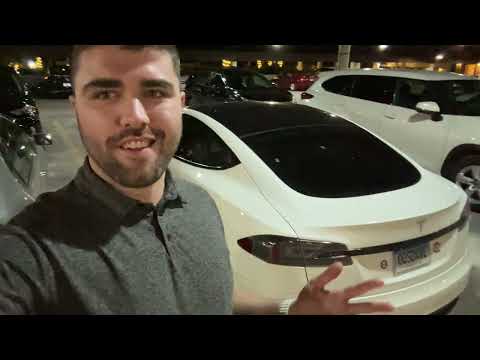
Will We Make It To Dinner With Tesla Full Self Driving Beta?
This video offers a first-time user's perspective on Tesla's Full Self-Driving (FSD) Beta, tested in a 2021 Model S Long Range equipped with... more the controversial yoke steering wheel. The reviewer, Branden Flasch, finds FSD Beta to be a mixed bag, highlighting impressive visualizations but criticizing its inconsistent and often unpredictable behavior. He notes instances of phantom braking, aggressive acceleration, and awkward maneuvers, concluding that it requires more mental effort to babysit than manual driving, thus defeating its purpose as a driver-assist system. The yoke steering is also deemed a poor combination with FSD Beta, making it harder to take over control. While acknowledging the technology's potential and its availability to more users, the reviewer ultimately labels it a "party trick" and not a practical product for daily use in its current state, suggesting it's several years away from being truly trustworthy. A notable discovery is a workaround for FSD Beta interventions by performing a system reset. less

Out of Spec Family Photo Ruined By EVgo
This video chronicles a frustrating attempt to set up and utilize EVgo's AutoCharge+ feature on a Tesla Model S, highlighting significant issues ... morewith the charging network. The primary takeaway is the unreliability and poor user experience of EVgo stations, with multiple units being non-functional or exhibiting connectivity problems. The reviewer details issues ranging from app connectivity failures and slow charging speeds (achieving only 50-110 kW when the car could handle much more) to physical damage on chargers and confusing payment systems. While the AutoCharge+ feature itself eventually worked on one specific unit after considerable effort, the overall experience with EVgo is deemed poor, contrasting sharply with the seamless Tesla Supercharger experience. The video suggests that while AutoCharge+ is a valuable feature for Teslas and other enabled EVs, the underlying infrastructure of EVgo stations remains a significant hurdle. less

Let's Find Out How Well Rivian R1T Charges And Drives After Cold Soaking Overnight
This video investigates the Rivian R1T's performance and charging capabilities after being left to cold soak overnight in temperatures between 10... more-20F. The reviewer found that while the vehicle's estimated range significantly decreased overnight (from 85 miles at 31% to 72 miles at 26%), the actual driving experience was acceptable, though initial efficiency was poor, likely due to battery heating and cabin climate control. Charging proved to be the most variable aspect. Initial charging speeds at an EVgo station were a disappointing 20-25 kW, but quickly ramped up to 80-100 kW, eventually hitting a station limitation of 209 amps (around 200 kW peak). A subsequent attempt at Electrify America showed better performance, reaching up to 140 kW and then 103 kW, with the vehicle eventually limiting charging to around 140 kW. The final test at a Freewire unit yielded a respectable 110-115 kW, which the reviewer deemed acceptable for free charging. The key takeaway is that while cold temperatures impact initial charging speeds and range estimates, the Rivian R1T is generally capable of charging and driving in cold weather, though preconditioning is highly recommended for optimal performance. less
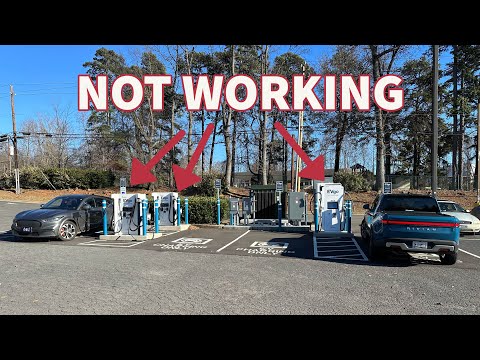
I Cannot Recommend This Charging Experience
The reviewer embarks on a critical assessment of EV fast charging infrastructure in Charlotte, NC, during a cold snap, highlighting significant reliab... moreility issues across multiple networks. The EVgo site visited was completely down, with the app incorrectly showing it as available. A FreeWire Boost unit, while initially functional, depleted its battery, leaving subsequent users with significantly reduced charging speeds. The Electrify America station, despite showing all units operational on the app, suffered from poor site design, stiff cold cables, and some non-functional chargers, though it ultimately performed better than expected. The video strongly criticizes the lack of reliability and communication from charging networks, concluding that Tesla's Supercharger network remains the only truly dependable option for long-distance EV travel without extensive planning. The reviewer expresses a desire for non-Tesla EVs but finds the current charging infrastructure makes them difficult to recommend for reliability. less

Taking a Different Approach To This Trip Charlotte to Atlanta and Back Getting My Rivian Back!
Branden Flasch embarks on a round trip from Charlotte to Atlanta and back, initially in a loaner Rivian R1T while his own truck undergoes service for ... morea detached underbody panel. The loaner R1T, a Launch Edition, performed adequately, though the tire pressure system proved finicky. The outbound journey to Atlanta was completed without a charging stop, achieving a respectable 2.08 miles/kWh. Upon retrieving his own R1T, which had its underbody panel replaced and tire rotation performed, Flasch noted the service addressed his concerns. The return trip included a stop at the Greenville, SC Electrify America station. While improved from a previous visit, with two of four chargers functional and one providing a disappointing 52 kW, the other unit delivered a strong 213 kW. Flasch also investigated a potential Rivian Adventure Network site at a local REI but found no signs of development. Overall, the trip highlights the ongoing improvements and persistent issues with public charging infrastructure, alongside the reliability of Rivian's service. less

This Is Getting A Bit Crazy: Charlotte to Atlanta and Back to Drop Off Rivian for Service
This video documents a challenging trip from Charlotte to Atlanta and back for Rivian service, highlighting significant issues with Electrify America ... morecharging infrastructure. The host's Rivian R1T required service due to a missing underbody panel, necessitating a drive to Atlanta as no local service centers were available. The journey was plagued by charging problems at Electrify America stations, with multiple chargers being non-functional, slow, or experiencing communication errors. This led to unexpected detours and extended charging times, significantly impacting the trip's efficiency and convenience. The host received a loaner Rivian R1T, which, while functional, was noted to be dirty and lacked desired tire specifications. The video underscores the frustration of owning a premium EV when charging infrastructure fails to meet expectations, impacting the overall ownership experience and potentially influencing purchasing decisions for other EVs. The host concludes that while the Rivian itself is a capable vehicle, the current state of public charging, particularly Electrify America, is a major drawback. less

600 Mile Day Trip in Rivian R1T from Charlotte to Outer Banks and Back - Slow Charging Galore!
This video documents a 600-mile day trip in a Rivian R1T from Charlotte to the Outer Banks and back, highlighting significant challenges with charging... more infrastructure. The reviewer, Branden Flasch, experienced painfully slow charging speeds, particularly at Electrify America and EVgo stations, often encountering non-functional chargers or vehicles occupying them for extended periods. He noted the Rivian's poor efficiency, averaging 1.87 miles per kWh over the trip, which necessitated frequent and lengthy charging stops. While some free charging was available, the overall experience was marred by the unreliability and slow speeds of public charging networks. The reviewer also criticized time-based charging billing, especially at EVgo, which penalizes users with slower charging speeds. The trip concluded with a return to home charging, which also proved to be slow, taking an estimated 16 hours to reach 70% charge. less

Taking My Rivian R1T To The Drag Strip And Running It Against Tesla!
The reviewer takes his Rivian R1T to Rockingham Dragway for a test and tune day, primarily to race against a 2022 Tesla Model 3 Performance. Despite t... morehe R1T's significant weight advantage (7200 lbs vs. ~4000 lbs), the drag strip runs were surprisingly close, with the R1T achieving a best quarter-mile time of 11.646 seconds, narrowly losing to the Model 3 Performance's 11.343 seconds. The reviewer notes the R1T's impressive consistency, running 11.6s and 11.7s repeatedly, though performance slightly degraded as the battery state of charge decreased. He experimented with different drive modes (Sport, Conserve, All-Purpose) and suspension settings, finding that reduced traction control aided launches. The video also briefly touches on the Rivian Adventure Network's construction status and a test of a Flow DC fast charger with the R1T, which proved successful. Overall, the R1T demonstrated strong, consistent performance on the drag strip, exceeding expectations for its size and weight, though it couldn't quite match the lighter, more performance-oriented Tesla Model 3 Performance. less

Rivian R1T 1000km Challenge Through the Carolinas!
Branden Flasch undertakes a 1000km (approx. 627 miles) road trip challenge in his 2022 Rivian R1T to benchmark its long-distance capability. The test,... more conducted in the Carolinas, aimed to replicate Bjorn Nyland's European challenges. Flasch highlights the R1T's "conserve mode" and "standard suspension" for comfort and efficiency. The vehicle performed admirably, completing the distance in a net time of 10 hours and 3 minutes after deductions for traffic and charging inefficiencies. The reviewer notes the R1T's solid range and reasonable efficiency, achieving 1.78 miles per kWh despite spirited driving. While praising the R1T as a "great road trip vehicle" with adequate charging infrastructure, Flasch suggests room for improvement in charger placement and spacing in North America compared to Europe. The test also included a brief experiment with different charging cables, yielding marginal benefits. less

Live: Rivian R1T 1000km Challenge
This live stream documents a 1000km (approximately 627 miles) challenge undertaken in a Rivian R1T, aiming to complete the distance as quickly as poss... moreible. The reviewer highlights the R1T's comfortable ride in standard suspension mode, its decent range despite not being the most efficient EV, and praises its overall build quality, noting it feels more premium than Teslas. The driver utilizes 'conserve' mode and standard suspension height for a balance of comfort and efficiency, with the vehicle often running in front-wheel drive on the highway. Positives include improved driver assist features and thoughtful design touches. However, the challenge was impacted by a few minor traffic delays and a faulty charging cable at one Electrify America station, which required a cable swap and resulted in a minor time deduction. The reviewer also notes that while the R1T's range is good due to its large battery, its efficiency isn't class-leading compared to more aerodynamic vehicles. The video also touches on Tesla's current pricing being too high and expresses a preference for Rivian's value proposition and focus on driver assist over full self-driving. less

300 Mile Day Trip to Raleigh in Rivian R1T for Rivian Stories Meetup!
The reviewer embarks on a 300-mile round trip from Charlotte to Raleigh in their Rivian R1T for a Rivian Stories meetup. The journey highlights the R1... moreT's efficiency, achieving an impressive 2.17 miles per kilowatt-hour on all-terrain tires, exceeding the reviewer's lifetime average. A significant portion of the trip was conducted in 'conserve' mode, which the reviewer advocates for its range benefits. Charging at an Electrify America station presented challenges, with some chargers down and others slow to activate, though ultimately a functional charger was found. The reviewer praises the convenience of gas station-style charging locations. A key critique is Rivian's limited lane-keeping assist functionality, which is restricted to mapped roads, making unmapped highway driving less convenient. Despite this, the reviewer expresses overall satisfaction with the R1T's comfort, efficiency, and performance, concluding the day with 11% charge remaining after 311 miles. less

Tested: Does Rivian Conserve Mode and Lowest Ride Height Actually Give You More Range?
This video thoroughly investigates the real-world impact of Rivian's Conserve mode and lowest ride height on the R1T's range. The reviewer, ... moreBranden Flasch, conducted a series of tests at 70 mph on a 66.5-mile loop, comparing All-Purpose mode with standard height against Conserve mode at both standard and lowest heights. The results indicate that Conserve mode offers a tangible benefit, improving efficiency by approximately 6.4% over All-Purpose mode, with minimal compromise in power for highway cruising. However, lowering the suspension to its lowest setting yielded negligible improvements in this specific test, with the "Conserve lowest" run showing only a marginal gain over "Conserve standard." Interestingly, a previous test of "Conserve low" at 70 mph was found to be even more efficient than the current "Conserve lowest" run. The reviewer concludes that switching to Conserve mode is a worthwhile strategy for road trips to maximize range and reduce charging costs, while the lowest ride height's benefit was not conclusively proven in this instance. less

Tested: 150kW vs 180kW vs 350kW with Rivian R1T - Does It Save Time?
This video thoroughly tests the charging speeds of the Rivian R1T across various Electrify America and EVgo charging stations, ranging from 150kW to 3... more50kW. Contrary to expectations, the results showed minimal time differences (less than 2 minutes) between the different power outputs when charging from 3% to 85%. The reviewer highlights that the Rivian's charging curve appears to target a consistent average speed, adjusting power delivery to meet this average rather than maximizing peak output. This suggests that for typical road trip charging sessions where drivers might unplug between 70-80%, the specific charger's rated power has less impact than anticipated. The reviewer advises that for shorter charging stops (30-40% SOC), higher-powered chargers offer a benefit, but for longer charges, the difference is negligible. The video also notes the unreliability of charging time estimates displayed by the vehicle. Overall, the R1T's software manages charging to provide a predictable experience, simplifying the process for the user. less

The Truth About Rivian R1T After 1 Month / 5k Miles - Here's What Rivian Can Improve And What I Love
After one month and over 5,000 miles, the Rivian R1T has proven to be a highly capable and enjoyable vehicle, earning the reviewer's strong recom... moremendation. Key strengths highlighted include exceptional comfort, particularly the cooled seats, and a capacitive steering wheel that is praised for its minimal nags. The attention to detail, from the integrated flashlight to the well-executed gear tunnel and power outlets, is a significant plus. The front trunk is noted as surprisingly useful, enhanced by a physical open/close button. However, the review identifies several areas for improvement. These include a lack of customizable driver profiles, the inability to use the bed camera when reversing with the tailgate open, and limitations on programming additional keys and phone keys. The top speed is considered too low at 112 mph, especially given the H-rated tires. The navigation system's reliance on Mapbox and Yelp for reviews is criticized, with a preference for Google Maps. Other points of contention include the inability to adjust drive modes or suspension height while using Driver+, limitations on suspension adjustment speed, unnecessary power vents, and a 32-amp mobile connector that is deemed insufficient for the vehicle's battery size. The reviewer also notes significant battery drain when the onboard inverter is left on overnight and the absence of a built-in dash cam. While acknowledging these drawbacks, the reviewer emphasizes Rivian's responsiveness to customer feedback through frequent software updates, which have significantly improved infotainment responsiveness, charging curves, and ride comfort, making the R1T a product that is continuously evolving for the better. less
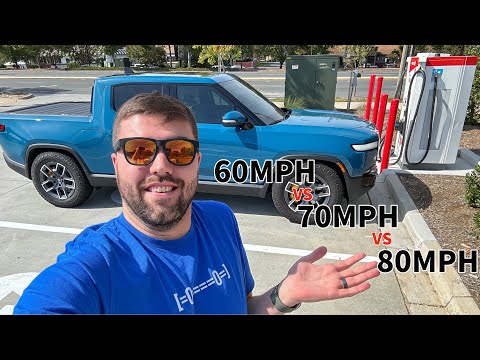
Tested: Speed Impacts Range - But By How Much? Testing Rivian R1T at 60MPH, 70MPH and 80MPH
This video thoroughly tests the range impact of varying speeds on the Rivian R1T, comparing efficiency at 60, 70, and 80 mph. The reviewer, Branden Fl... moreasch, found that while slower speeds yield better efficiency, the difference might be less significant than commonly believed. At 60 mph, the R1T achieved approximately 2.62 miles/kWh, dropping to 2.25 miles/kWh at 70 mph, and further to 2.02 miles/kWh at 80 mph. Despite the lower efficiency at higher speeds, Flasch concludes that the trade-off might be worthwhile for overall trip time, especially with robust fast-charging infrastructure. He prefers faster driving and more frequent, albeit potentially longer, charging sessions to minimize total travel time. The reviewer also notes that the all-terrain tires may be a significant factor in the tested efficiency. less

Final Stretch Home In Rivian R1T! - 1400 Miles in 36 Hours Across 5 States!
The reviewer embarks on a long-distance road trip in a Rivian R1T, covering 1400 miles across five states in 36 hours. The journey highlights the prac... moreticalities of EV road-tripping, focusing heavily on charging experiences. While the R1T's performance and comfort are implicitly praised through its use on such a demanding trip, the review zeroes in on the inconsistencies and frustrations with public charging infrastructure. The reviewer encounters numerous issues with Electrify America and Francis Energy chargers, including faulty cables, slow charging speeds, and unreliable operation, particularly noting the detrimental effects of time-based billing. Despite these challenges, the reviewer successfully navigates the trip, showcasing the R1T's capability to cover significant distances, albeit with a strong emphasis on the need for improved and more reliable charging solutions. less

Going to Charlotte C&C, Drive Electric Week Event and Checking Out New Rivian Adventure Network Site
Branden Flasch provides a day-in-the-life vlog showcasing his Rivian R1T, attending Charlotte Cars & Coffee and a Drive Electric Week event. While... more Cars & Coffee was deemed disorganized, the Drive Electric Week event was a positive experience, offering a chance to see other EVs like the rare Ford Ranger Electric. The video also details a charging test at Electrify America, confirming a functional high-power station, and provides an update on the construction of a new Rivian Adventure Network site in Charlotte, highlighting its progress and proximity to a Tesla Supercharger. The reviewer expresses excitement for the new charging site's opening, referencing potential delays seen at other locations. The latter part of the video focuses on charging tests at a Circle K and discusses plans for future efficiency testing, including speed and accessory impact on range. Overall, the video offers a practical look at EV ownership, charging infrastructure, and the growing Rivian ecosystem. less

All The Way To 14,000ft! Rivian Road Trip - Colorado to Texas
This video documents a road trip from Colorado to Texas in a 2022 Rivian R1T, focusing on the experience of driving up Pikes Peak. The reviewer highli... moreghts the truck's performance and capability, particularly its effortless power delivery even at high altitudes and its stable ride on challenging terrain. The Pikes Peak ascent, despite a temporary road closure due to weather, was a key highlight, showcasing the vehicle's ability to handle steep inclines and varying conditions. The reviewer also touches upon charging experiences, noting both complimentary sessions and the performance of Electrify America stations, with mixed results. Practical aspects like storage, interior comfort, and the effectiveness of features like 'pet comfort' mode are also mentioned. Overall, the R1T is presented as a capable and enjoyable vehicle for long-distance travel and adventurous excursions, though charging infrastructure reliability remains a point of consideration. less