
Autoline Network is a premier distributor dedicated to delivering comprehensive automotive news and insights to enthusiasts and industry professionals alike. Specializing in global automotive developments, the network provides in-depth coverage of everything from cutting-edge EV and AV technology to ICE advancements, car sales trends, and financial earnings reports. Viewers can expect expert analysis and reviews of the latest vehicles, ensuring a well-rounded understanding of the automotive landscape.
The channel distinguishes itself through exclusive content, featuring top auto executive interviews and detailed breakdowns of automotive innovations. With a focus on clarity and expert opinion, Autoline Network serves as an essential resource for anyone seeking to stay informed about the dynamic world of automobiles, from technological breakthroughs to market performance.
The channel distinguishes itself through exclusive content, featuring top auto executive interviews and detailed breakdowns of automotive innovations. With a focus on clarity and expert opinion, Autoline Network serves as an essential resource for anyone seeking to stay informed about the dynamic world of automobiles, from technological breakthroughs to market performance.

World's First Cybertruck Teardown - Steer-by-Wire, 48V, Battery & Gigacastings
This video provides an in-depth look at the initial stages of Caresoft's teardown of the Tesla Cybertruck, focusing on key technological advancements. The review highlights the innovative steer-by-wire system, noting its separation from traditional mechanical linkages and the implementation of re...


Latest Additions
Showing 24 of 868 total titles. Page 8 of 37.

Is Toyota’s EV Strategy Brilliant or Bonkers?
This episode of Autoline After Hours critically examines Toyota's EV strategy, questioning whether their heavy reliance on hybrids and plug-in hy... morebrids is a brilliant hedge or a detrimental delay. The panel, featuring Sam Fiorani and Dan Neil, argues that Toyota's approach, while potentially profitable in the short term by focusing on high-margin vehicles, risks missing out on the rapidly growing pure EV market. A key concern raised is Toyota's potential struggle to secure battery supply chains in the future if they delay their EV transition. While Toyota cites carbon neutrality goals and the economic benefits of hybrids, the panelists counter that the long-term trajectory clearly favors electrification, and the practical adoption of PHEVs is hampered by low charging rates. The discussion also touches upon global excess manufacturing capacity, the challenges faced by EV startups like Rivian and Fisker, and the future of exotic cars in an electric era, with a consensus that electrification offers performance benefits even for high-end vehicles. less

The IRA Threatens a Half Dozen Automakers - Autoline After Hours 635
This episode of Autoline After Hours delves into the significant impact of the Inflation Reduction Act (IRA) on the automotive industry, particularly ... morefocusing on Ford's new battery plant in Marshall, Michigan. The panel discusses Ford's $3.5 billion investment in a wholly-owned subsidiary utilizing CATL's LFP battery technology, aiming to reduce costs and dependence on China. Concerns are raised about potential political and Chinese government interference, though the consensus suggests the deal will proceed. The discussion also touches upon Ford's current EV market position, noting their second-place sales ranking behind Tesla, but highlighting profitability challenges and recent production halts for the F-150 Lightning due to a battery fire. The IRA's role in incentivizing domestic EV and battery production is explored, with a focus on its potential to boost the US manufacturing landscape, though challenges remain for foreign automakers and in navigating complex incentive structures. The episode concludes by examining the IRA's influence on pricing strategies and its potential to reshape the competitive dynamics within the EV market. less

China’s EV Juggernaut Prepared For Global Domination - Autoline After Hours 634
This Autoline After Hours episode delves into China's burgeoning EV dominance and its implications for the global automotive market. The panel, f... moreeaturing experts Tu Le, Gary Vasilash, and John McElroy, highlights that while Western automakers once profited greatly in China, they are now being outmaneuvered by domestic players, particularly in the EV space. The discussion emphasizes China's significant lead in EV sales, technological integration (especially connectivity), and its growing export capabilities. The Inflation Reduction Act (IRA) is analyzed as a potential, albeit complex, tool for the US to foster domestic production, though concerns remain about reliance on Chinese supply chains and the ability of US automakers to compete on price. The consensus suggests that while Western companies are struggling with speed and adapting to the digital-first nature of modern vehicles, Chinese companies are rapidly advancing, potentially posing a significant threat to established global players. less
Tesla Price War, Prelude To An EV Apocalypse - Autoline After Hours 633
This episode of Autoline After Hours delves into Tesla's aggressive price cuts and their ripple effects across the EV industry. The panel agrees ... morethat Tesla initiated these cuts primarily because they could, leveraging superior profit margins (16-17% vs. competitors' 8% or less) and a desire to drive market share, potentially at the expense of rivals. While softening demand and the need to qualify for tax credits (by dropping the Model Y below $55,000) are factors, Tesla's core strategy appears to be a 'Henry Ford moment' – using manufacturing cost advantages to gain dominance. The discussion highlights the pressure this puts on legacy automakers like GM and Ford, as well as startups like Lucid and Rivian, with Rivian already announcing staff cuts. The panel also touches on the complexities of the Inflation Reduction Act's incentives, particularly for commercial vehicles and leasing, and the ongoing challenges of securing critical mineral supply chains for battery production. Despite strong overall economic indicators, concerns about consumer affordability persist, especially with rising interest rates, though a more affluent buyer base currently supports the market. less
High-Tech Simulators: The Path to Zero Prototypes - Autoline After Hours 632
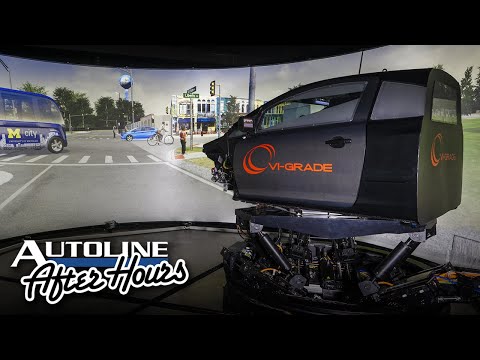
This episode of Autoline After Hours delves into the revolutionary world of simulation-driven vehicle development with Michael Hoffmann of VI-grade. T... morehe core argument presented is that advanced driving simulators can significantly reduce, if not eliminate, the need for physical prototypes. Hoffmann highlights how VI-grade's technology integrates realistic motion, visuals, and sound to provide engineers with an accurate driving experience, enabling rapid A-to-B comparisons for components like suspension and tires. This approach drastically cuts development time and costs, with one OEM reporting a 30% reduction. The discussion also touches upon the evolution from CAD and CAE to driver-in-the-loop simulation, emphasizing the human experience as crucial for final design decisions. The latter half of the show shifts to the Chevrolet Corvette E-Ray, with Don Sherman providing insights into its hybrid powertrain, all-wheel-drive capabilities, and its positioning as a "Swiss army knife" within the Corvette lineup, extending performance and all-weather usability. Sherman also speculates on the future of the Corvette brand as a standalone entity, potentially including an SUV and a high-horsepower hybrid 'Zora' model. less

Canada’s Top Secret Project To Make EVs - Autoline After Hours 631
Project Arrow represents a significant showcase of Canadian automotive technology and manufacturing capabilities, aiming to demonstrate a zero-emissio... morens future. The initiative, spearheaded by the Automotive Parts Manufacturers Association (APMA), successfully brought together over 500 suppliers to create a fully Canadian-content electric vehicle. Key technological highlights include a dual-motor, 550-horsepower powertrain with a graphene-enhanced lithium-ion battery offering an estimated 500 km range, and innovative solutions like the elimination of the onboard charger by E-Leap. The project also features a transparent photovoltaic glass roof for range extension and structural components made from 3D-printed chassis and magnesium B-pillars. While the vehicle's design prioritizes functionality and showcases supplier capabilities, its potential for mass production remains a future consideration, with the immediate goal being to prove Canada's technical prowess and attract investment. The project's success lies in its collaborative spirit and its demonstration of what's possible with Canadian ingenuity, even with a modest $20 million CAD investment. less

CES Automotive Brain Dump
This episode of Autoline After Hours features a lively discussion among automotive experts Paul Eisenstein, Chris Thomas, Gary Vasilash, and John McEl... moreroy, dissecting their key takeaways from CES. A significant portion of the conversation revolves around the evolving landscape of the software-defined vehicle, with panelists exploring its implications for monetization and functionality. Chris Thomas highlights innovative micro-radar technology capable of detecting heartbeats and breaking glass, while Paul Eisenstein expresses excitement over the Ram Revolution concept pickup, praising its radical design that leverages electrification for a completely new vehicle layout, including a pass-through midgate and front storage. The discussion also delves into the controversial topic of range extenders for electric pickups, with concerns raised about environmental impact versus consumer anxiety. Other notable mentions include e-leap Power's potential to eliminate onboard chargers, American Axle's compact e-axle with integrated cooling, and BMW's color-changing i Vision Dee concept. The panel also touches on the growing automotive presence at CES, the unique naming of the Sony Honda Afeela, and the potential for aftermarket ADAS upgrades. less

What Did the Auto Industry in 2022 Teach Us About 2023? Autoline After Hours 629
This episode of Autoline After Hours kicks off 2023 by dissecting the key takeaways from the previous year and forecasting industry trends. The panel ... morehighlights the impressive strides made by Hyundai, Kia, and Genesis, particularly with the IONIQ 5, noting their ability to challenge Tesla's dominance with accessible technology and distinctive design. The rise of electric pickup trucks, exemplified by the Ford F-150 Lightning, is also a significant point of discussion. The conversation delves into the challenges faced by EV startups like Rivian and Lordstown Motors, emphasizing the difficulties of scaling production and navigating financial pressures. A key concern raised is the tepid consumer interest in EVs, largely attributed to high prices and charging infrastructure limitations, despite substantial industry investment. The discussion also touches upon the evolving landscape of autonomous driving technology, with a consensus that widespread adoption is still a distant prospect due to complexity and cost. Finally, the panel anticipates a potential shift in the market dynamics, with easing supply chains and the possibility of increased inventory and negotiation, though affordability remains a significant hurdle. less

The Best and Worst of 2022, and What's to Come in 2023 - Autoline After Hours 628
This Autoline After Hours episode reflects on the best and worst of 2022 automotive trends and looks ahead to 2023. The panel discusses the ambitious ... moreMercedes-Benz EQXX concept with its 625-mile range, questioning its practicality and cost versus consumer demand for a more attainable 450 miles. Chrysler's Airflow concept is deemed a dated design, with uncertainty surrounding the brand's future within Stellantis, overshadowed by Dodge's EV efforts. GM's dedicated EV platform strategy (Ultium) is contrasted with Ford's retrofitted approach for the F-150 Lightning, with the consensus leaning towards GM's long-term scalability. The discussion highlights the current perception of EVs as luxury niche vehicles, citing the high cost and limitations like towing for the F-150 Lightning. The entry of tech companies like Sony and Apple into the automotive space is explored, with skepticism about their profitability given the capital-intensive nature of car manufacturing. The VW ID. Buzz is analyzed as a potential halo vehicle but unlikely to be a mass-market savior due to its expected high price point, echoing the fate of the resurrected Beetle. Cadillac's ultra-luxury Celestiq is viewed as a brand-image play rather than a volume seller, with the Lyric positioned to attract mainstream luxury EV buyers. A KPMG survey reveals a significant drop in executive expectations for EV market share by 2030, with Tesla leading the pack, but no GM brands receiving votes. The panel debates the pace of EV adoption, citing high costs, charging infrastructure challenges, and consumer preference for the convenience of gasoline cars, though acknowledging ongoing technological advancements and regulatory pressures. The episode concludes with a stark look at Tesla's market cap decline, questioning the sustainability of its valuation amidst broader market shifts and Elon Musk's controversial ventures. less

Is Toyota Crazy Or Can Hybrids Save The Ice? - Autoline After Hours 627
This Autoline After Hours episode features Jordan Choby from Toyota discussing the company's strategy regarding electrification. Choby emphasizes... more that Toyota is committed to EVs but believes a multi-powertrain approach, including hybrids and plug-in hybrids, is crucial during the transition to carbon neutrality. He highlights Toyota's ongoing investment in improving ICE efficiency and developing advanced hybrid systems, such as the strong hybrid and plug-in hybrid powertrains found in models like the Prius, Camry, RAV4, Tundra, and Sequoia. The discussion also touches upon the potential of fuel cells, with Toyota scaling its Mirai technology for commercial applications like semi-trucks and exploring stationary power generation. While acknowledging the challenges, particularly around infrastructure costs for hydrogen, Choby expresses optimism about the growing government support and commercial sector adoption in the US. The conversation also briefly delves into the complexities of EV development, battery technology (including solid-state), and the competitive landscape among automakers. less

Cadillac Celestiq EV: The Inside Story From The Chief Engineer
The Cadillac Celestiq represents a bold, hand-built, and highly customizable vision for the brand's electric future. Chief Engineer Tony Roma det... moreails the ambitious program, emphasizing the shift from a hybrid concept to an all-electric halo car. The Celestiq is positioned as the ultimate expression of Cadillac's design and technology, with a focus on exclusivity and a bespoke customer experience. Roma highlights the innovative manufacturing approach, including the use of large castings and carbon fiber panels, and the meticulous hand-assembly process yielding only two cars per day. While not a track-focused machine, the Celestiq promises an athletic and refined driving experience, thanks to its advanced chassis technology, all-wheel-drive system, and unique battery packaging. The program pushes boundaries in customization, allowing for extensive personalization, though with clear communication about cost and durability implications. The interview also touches upon the pioneering use of new technologies like Ultra Cruise and advanced lighting, many of which are expected to trickle down to other Cadillac models. less

Jeep's Battle Royale with Bronco, Scout & Everyone Else
This episode of Autoline After Hours features Jim Morrison, SVP & Head of Jeep North America, discussing the brand's strategy amidst intense ... morecompetition from Bronco and the returning Scout. Morrison highlights Jeep's successful reintroduction of the Wagoneer and Grand Wagoneer, noting their appeal to a new, affluent customer base and their strong performance in the luxury SUV segment, even achieving the number two sales position. He emphasizes the brand's commitment to listening to customer needs, which has driven product development, including the expansion of the Grand Cherokee and Wagoneer lines with long-wheelbase variants. A significant portion of the discussion focuses on Jeep's electrification strategy, particularly the success of the 4xe plug-in hybrid models for Wrangler and Grand Cherokee. Morrison explains how the 4xe technology enhances off-road capability with instant torque and quiet operation, positioning it as the 'next 4x4'. He also touches upon the growing popularity of off-roading, attributing it to a 'perfect storm' of factors including post-pandemic desires for adventure and the availability of accessible off-road parks. While acknowledging the challenges of electric vehicle off-roading, Morrison assures that Jeep is actively developing solutions to manage torque and weight. The conversation also touches on the discontinuation of the EcoDiesel in the Wrangler, making way for the more powerful 4xe and V8 options, and the brand's strong market position despite increased competition. less

How the Giant Supplier ZF is Bringing OEMs Into the Digital Age - Autoline After Hours 624
ZF, a century-old automotive supplier, is undergoing a significant transformation, shifting its focus from traditional transmissions to electronics an... mored software. The company envisions itself as a technology provider for the mobility industry, with the microchip now seen as the 'new gear' and 'software first, digital always' as its guiding principle. ZF is strategically positioned across four key activity fields: e-mobility, automated driving, vehicle motion control, and integrated safety. While acknowledging the decline of traditional transmissions, ZF is fully prepared for the electrification trend, offering electric motors, power electronics, and inverters alongside one or two-speed transmissions. The company emphasizes leveraging economies of scale to reduce costs for OEMs and consumers. ZF is also actively involved in automated and autonomous driving, collaborating with Nvidia on high-performance computers for both passenger and commercial vehicles, with production slated to begin in two years. They are also focusing on Level 2+ driver assistance systems and Level 4 autonomous shuttles for specific applications like highway transit and shipping yards. ZF's approach to the EV transition involves integrating its workforce, providing extensive training, and retaining talent. The company is also open to flexible partnerships with OEMs, including co-development and manufacturing, and is actively engaging with EV startups to foster speed and agility. ZF is committed to investing in e-mobility, driven by strong market demand and regulatory support, and has made the strategic decision to cease investment in next-generation ICE transmissions. less
A Completely Different Kind of Car Suspension - Autoline After Hours 623
Autoline After Hours features an insightful discussion with Christian Steinmann, CTO of ClearMotion, about their revolutionary active suspension syste... morem. Unlike adaptive systems, ClearMotion's technology actively counteracts road imperfections using an actuator and sensor, akin to noise-canceling headphones. This system promises enhanced comfort, improved handling by keeping the vehicle flat, and even new entertainment possibilities, such as synchronized motion for movies. The technology is slated for production with an unnamed luxury automaker in late 2024. Steinmann highlights the system's compact design, proprietary software, and a focus on scalability from premium to mass-market vehicles. The latter half of the show delves into the strategic necessity for legacy automakers to spin off their ICE operations, with Renault and Volvo leading the way, a move advocated by the panel as a path to greater efficiency and focus in a rapidly evolving industry. less

The Industry: What Legacy Automakers Need to Unlearn From EV Startups
This episode of 'The Industry' features insights from Caresoft Global's Matthew Vachaparampil and Terry Wifechovsky, who analyze vehicl... morees for competitive benchmarking. Their core message for legacy automakers is the critical need to 'unlearn' ingrained processes and specifications inherited from the internal combustion engine era. They highlight Tesla and other EV startups' agility, characterized by rapid iteration, continuous improvement, and a higher tolerance for risk, contrasting sharply with traditional OEMs' slower, model-year-based update cycles. Key takeaways include the advantage of virtual modeling and simulation over physical prototyping, the importance of adapting to a faster 'automotive clock speed,' and the necessity of shedding outdated requirements, such as those related to engine vibration, which are irrelevant in EVs. The discussion also touches upon the future market landscape, with Joe McCabe predicting a plateau in North American sales volumes and the inevitable rise of Chinese automakers establishing manufacturing footprints globally. The experts emphasize that while legacy automakers must maintain their current profitable businesses, they must simultaneously foster a learning organization capable of embracing change and risk to compete effectively in the evolving EV market. less

AAH 622 - From EV-1 to VIA Motors Bob Purcell Talks All Things Electric
Bob Purcell, CEO of VIA Motors, details the company's evolution from early EV efforts at GM to their current focus on modular, scalable electric ... moremedium-duty truck chassis. VIA's 'V-Trucks' platform, built on a skateboard architecture, is designed for flexibility across Class 2-5 vehicles, with production slated for the second half of 2024. Purcell highlights the economic advantages for fleets, including lower operating costs due to fuel and maintenance savings, and the potential to leverage the Inflation Reduction Act's incentives. He emphasizes VIA's strategy of listening to customer needs and tailoring solutions, differentiating them from larger competitors. The company is merging with Ideanomics to offer a comprehensive package including financing and charging solutions, with a focus on profitable, measured volume rather than mass production. less

Why Toyota Is Doing A U-Turn With Its EV Strategy
Autoline After Hours discusses Toyota's significant pivot in its EV strategy, moving from a strong hybrid focus to a full-scale electric push. Th... moree panel, featuring industry experts, analyzes the Reuters report indicating Toyota's realization of falling behind competitors like Tesla in cost efficiency and EV development. Key points include Toyota's potential halt of existing EV projects to focus on a new, dedicated EV platform, a process estimated to take around five years. The discussion highlights the challenges legacy automakers face in transitioning to EVs, including supply chain issues for battery materials and the high cost of development. While Toyota's hybrid sales remain strong, the shift signifies a critical acknowledgment of the evolving automotive landscape and the need to compete directly with EV leaders. The panel also touches upon the complexities of the Inflation Reduction Act and the global race for battery materials, suggesting that while Toyota's move might create a temporary gap, it's a necessary step for long-term competitiveness. less

A GM Veteran’s Fight Through The Corporate Bureaucracy - Autoline After Hours 620
This Autoline After Hours episode features John Smith, former Head of Cadillac, discussing his career at GM and the turnaround of the Cadillac brand. ... moreSmith highlights the critical role of the Cadillac Escalade in saving the brand from decline, emphasizing that without this luxury SUV, Cadillac would likely be defunct today. He details the internal struggles to get the Escalade approved, battling against GM's internal brand sorting processes and a prevailing notion that Cadillac should remain solely a car brand. Smith also touches upon the "Art and Science" design philosophy, which revitalized Cadillac's image and led to significant sales growth in the early 2000s. The conversation then pivots to the current EV landscape, with Smith expressing skepticism about the rapid transition, citing infrastructure challenges, high costs, and uncertain consumer demand. He argues that while EVs will be a significant part of the future, forcing the transition without addressing these issues is unsustainable and potentially detrimental to consumers and the industry. less

Buick Design and the Brand's Electric Future
Autoline After Hours features Bob Boniface, Buick's Director of Global Design, discussing the brand's design evolution and electric future. ... moreBoniface details his career path, highlighting significant projects like the Dodge Intrepid ESX concept, Chrysler 300C, Jeep Liberty, Chevy Camaro, and Chevy Volt. The conversation heavily focuses on Buick's new design language, exemplified by the Wildcat EV and Electra-X concepts. Boniface emphasizes leaning into Buick's heritage while embracing modern EV architecture, aiming for a distinct, sculptural, and confident aesthetic that differentiates Buick from other GM brands like Cadillac and Chevrolet. Key takeaways include the strategic use of iconic names like Wildcat and Electra, the importance of aerodynamic efficiency in EV design, and the balancing act of catering to global markets, particularly China, while maintaining a strong brand identity. The discussion also touches on the challenges and opportunities of designing for electric powertrains and the evolving role of large displays in vehicle interiors. less

Legacy Supplier Embraces EV Tech - Autoline After Hours 618
Autoline After Hours features Jeff Hemphill, CTO of Schaeffler, discussing the company's significant pivot from traditional mechanical components... more to advanced EV technologies. Hemphill highlights Schaeffler's successful transition by leveraging existing expertise in areas like industrial electric motors and coatings for new applications such as e-axles, chassis mechatronics, and advanced battery systems. The discussion emphasizes the company's strategy of reassembling internal capabilities rather than starting from scratch, while also addressing the challenge of attracting young software talent. The conversation touches upon the demand for hybrid and BEV technologies, with a specific focus on Schaeffler's hybrid module for Ford and their approach to developing efficient electric motors, including innovative techniques like direct injected slot cooling and passive field weakening. The segment also explores the potential and challenges of hub motors, particularly for niche applications like autonomous street sweepers and robo-taxis, and contrasts the differing market demands between the US and Europe. The interview underscores the rapid pace of technological change in the automotive industry and Schaeffler's proactive adaptation. less

Flying Cars, Falling Auto Stocks and The Decline of Brand Loyalty
This episode of Autoline After Hours tackles several critical automotive industry trends. The panel discusses the diminishing relevance of traditional... more auto shows, highlighting their high costs and the shift towards digital or experiential events. A significant portion is dedicated to the Hertz-GM deal, exploring its potential to accelerate EV adoption by providing widespread consumer experience, though concerns about charging infrastructure reliability and vehicle maintenance in rental fleets are raised. The discussion then pivots to the alarming decline in brand loyalty, attributed to inventory shortages, poor dealer experiences, and the disruptive influence of electrification and new technologies. Finally, the panel examines the trend of automakers aiming to produce their own chips, questioning their competency while acknowledging the strategic necessity driven by past supply chain failures. less

Mazda Didn't Think Up The Miata, This Guy Did - Autoline Exclusives
This Autoline Exclusives episode delves into the origin story of the Mazda MX-5 Miata, crediting automotive journalist Bob Hall as the visionary behin... mored the concept. Hall recounts his lifelong fascination with British sports cars and his desire to combine their driving pleasure with Japanese reliability. The narrative highlights his persistent efforts at Mazda, including a pivotal chalkboard drawing and late-night work sessions, to champion the lightweight sports car idea. The discussion also touches upon the challenges faced, such as initial skepticism from management and the surprising customer price expectations during clinics, which ultimately led to a more profitable pricing strategy. Beyond the Miata, Hall shares insights on the broader automotive industry, critiquing current EV design trends, the pitfalls of legacy automakers' processes, and the importance of genuine innovation over imitation. He advocates for dedicated, agile EV divisions within established companies to overcome cultural and procedural baggage. less

Tim Kuniskis Defends Dodge Going Electric - Autoline After Hours 616
Dodge CEO Tim Kuniskis passionately defends the brand's transition to electric vehicles, emphasizing a commitment to maintaining the 'muscle... more car' ethos. He argues that electrification offers significant performance advantages, but acknowledges the challenge of replicating the visceral, emotional experience of traditional internal combustion engines. Dodge aims to achieve this through unique features like the 'Fratzonic Chambered Exhaust' for sound, an 'eRupt' transmission for shifting feel, and the 'R-Wing' for aerodynamic styling, even if these add inefficiencies. Kuniskis stresses that Dodge will not chase mainstream appeal, instead focusing on a dedicated 'Brotherhood' of enthusiasts who value personality and performance over practicality. The brand's strategy involves leading with aspirational, high-performance EVs like the Charger Daytona SRT Concept, while also introducing models like the Hornet to broaden appeal. The discussion highlights Dodge's focus on psychographics over demographics, aiming to attract those who want their vehicle to represent their identity, regardless of age. less

NACTOY: The Best New Cars & Trucks of the 2023 Model Year - Autoline After Hours 615
This episode of Autoline After Hours features a panel of automotive journalists discussing the semifinalists for the North American Car, Truck, and Ut... moreility of the Year Awards. The conversation covers a wide range of vehicles, from the Acura Integra and BMW i4 to the Ford F-150 Lightning and Kia EV6. While the panelists offer insights into the driving dynamics, design, and practicality of each contender, a recurring theme is the evolution of electric vehicles and their increasing presence in the awards. The discussion highlights both the strengths and weaknesses of various models, with particular attention paid to the Genesis G80 EV's stealthy design, the BMW iX's polarizing aesthetics, and the F-150 Lightning's potential limitations in towing range despite its overall excellence as an EV. The segment also touches upon the challenges of charging infrastructure and the varying approaches automakers take to EV platforms. less